

The Septic Drainage Field: Your Yard’s Hidden Wastewater Workhorse
A septic drainage field is the underground network of perforated pipes and gravel trenches that receives partially treated wastewater from your septic tank and filters it safely back into the ground. Here is a quick overview of what it does and why it matters:
- What it is: A series of buried perforated pipes surrounded by gravel, installed in your yard to disperse and treat household wastewater
- What it does: Filters effluent through gravel and soil, where bacteria destroy pathogens and nutrients are absorbed before reaching groundwater
- How big it is: A typical 3 to 4 bedroom home requires roughly 600 to 900 square feet of drain field area
- How long it lasts: 20 to 30 years with proper maintenance, but as little as 5 to 10 years without it
- Why it matters: It handles approximately 55% of your home’s total wastewater treatment, which is actually more than the tank itself
Most homeowners think of the septic tank as the heart of their wastewater system. But here is the truth: your septic tank only handles about 45% of the treatment process. The real heavy lifting happens silently underground, in the drain field beneath your lawn. When it works, you never notice it. When it fails, you absolutely will, and the repair bill can be incredibly high for a full replacement.
Understanding how your drain field works, what can go wrong, and how to protect it is one of the smartest things you can do as a homeowner. This is especially true in Palmer, AK, where soil conditions, freeze-thaw cycles, and long winters add extra stress to these systems year-round.
The Drain Masters team has more than two decades of hands-on experience helping Palmer, AK homeowners protect septic drainage field systems from preventable failures. In the sections below, we explain how a drain field works, what can go wrong, and how to help it last for decades.
What is a Septic Drainage Field and How Does It Work?
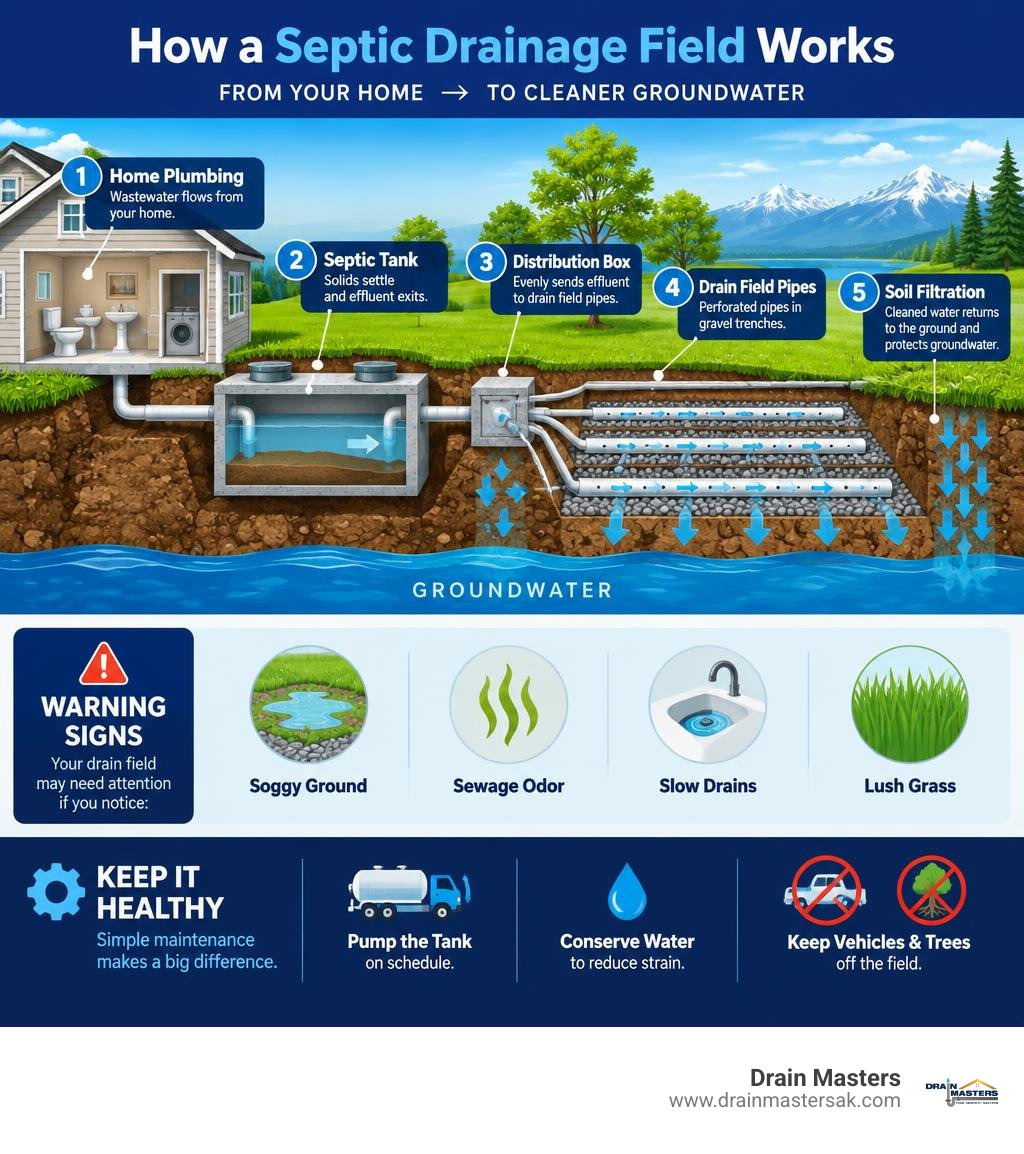
To understand how a septic drainage field works, it helps to think of your onsite wastewater system as a highly efficient, multi-stage biological purification plant. When you flush a toilet, run the washing machine, or wash dishes, that water does not just disappear. It journeys through a carefully designed ecosystem that protects your family, your property, and the local environment.
The final, and most critical, step of this journey takes place in the soil absorption area. Here, the liquid effluent meets a complex biological network of soil microbes, oxygen, and earth layers. Without this final phase, raw or semi-treated sewage could pool on the surface of your lawn or seep directly into the local water table, creating a severe environmental and health hazard.
The Step-by-Step Wastewater Treatment Process
Wastewater treatment is a continuous, gravity-driven and sometimes pump-assisted process that relies on simple physics and biology:
- Primary Treatment in the Tank: All household wastewater flows into the septic tank. Heavy solids settle to the bottom as sludge, while lighter greases and oils float to the top as scum. Anaerobic bacteria, which live without oxygen, begin breaking down the organic solids in this oxygen-depleted environment.
- Distribution to the Field: The relatively clear liquid in the middle, known as effluent, exits the tank. It passes through an effluent filter and flows into a distribution box. The distribution box helps split the effluent evenly among the drain field trenches so that no single area becomes overloaded.
- Percolation Through Gravel: Effluent trickles out of perforated PVC pipes and into a bed of clean, washed gravel. This gravel layer acts as a temporary storage buffer and allows the liquid to slowly and evenly distribute across the soil surface below.
- Soil Filtration and Pathogen Destruction: As the liquid percolates down through the soil, beneficial microbes in the biomat filter out remaining organic particles. Aerobic bacteria, which thrive on oxygen in the soil, help break down harmful pathogens. Soil minerals also bind with nutrients such as phosphates, helping limit their movement deeper into the ground.
If you ever experience slow drains or gurgling pipes before wastewater reaches the tank, the issue may be a clog closer to home. Having a professional clear a stubborn household clog can restore flow and help rule out an indoor drainage problem before your septic system is blamed.
Key Components of a Conventional Septic Drainage Field
A conventional gravity-fed septic drainage field is built with a few basic, durable materials designed to withstand decades of underground use. Local permitting requirements and site conditions determine the final layout and materials.
- Perforated PVC Pipes: Typically 4 inches in diameter, these heavy-duty pipes feature pre-drilled holes. They are installed with the holes facing downward to allow effluent to weep out along the entire length of the trench.
- Washed Gravel or Crushed Stone: This aggregate layer, usually 3/4 to 1.5 inches in size, surrounds the pipes. It keeps soil from collapsing around the pipe holes while providing open pathways for liquid storage and airflow.
- Geotextile Fabric: Also called filter fabric, this permeable sheet is laid directly over the gravel bed before the soil is backfilled. It allows air and moisture to pass through but helps prevent fine dirt and sand from clogging the gravel spaces.
- Soil Backfill: The final layer of native soil is mounded slightly over the trenches to shed rainwater. It is seeded with grass to stabilize the ground and assist with natural water uptake.
Sizing and Designing Your Leach Field
You cannot simply dig a few trenches in a random corner of your yard and hope for the best. Designing a septic drainage field is a precise science that requires a deep understanding of soil mechanics, household water usage, and local environmental codes. A poorly sized system can clog and fail within a few years, while a properly designed system can quietly do its job for decades.
Several factors dictate the final footprint and design of your absorption field, including the number of bedrooms in your home, the physical characteristics of your soil, and the depth of the local water table.
| Soil Percolation Rate (Minutes per Inch) | Suitability for Traditional Field | Required Trench Length (Approx. per Bedroom) |
|---|---|---|
| Under 1 MPI | Too fast and may require a special design to protect groundwater | Special design required |
| 1 to 5 MPI | Excellent absorption | ~60 to 75 linear feet |
| 6 to 30 MPI | Moderate absorption | ~75 to 110 linear feet |
| 31 to 60 MPI | Slow absorption | ~110 to 165+ linear feet |
| Over 60 MPI | Often unsuitable for conventional systems | Alternative system may be required |
Conducting a Soil Percolation Test
Before a design can be approved, a soil percolation test, commonly called a perc test, must be performed. This test measures how quickly water drains through the soil on your property.
A professional excavates several test holes in the proposed drain field area. The holes are pre-soaked to simulate wet spring conditions, filled with water, and monitored to see how many minutes it takes for the water level to drop by one inch.
In addition to the perc test, a technician evaluates soil morphology, including its layers, color, and texture, to identify the limiting zone. The limiting zone may be the highest seasonal water table or a restrictive layer such as bedrock. Required separation distances vary by local code, so a qualified septic professional should confirm the design before installation.
If you are buying a home or planning an addition and are not sure where your existing lines run, a closer look at your underground lines can locate connections and reveal the condition of accessible piping.
Palmer, AK homeowners can also use the Drain Masters seasonal sewer and drain insights to better understand how frozen ground, drainage issues, and household habits can affect buried plumbing and wastewater systems before a project begins.
Sizing Calculations and Local Regulations
Once we know your soil’s percolation rate, we calculate the required size of your field based on your home’s potential daily wastewater flow. This is determined by the bedroom count rather than the current number of occupants because bedrooms reflect the home’s long-term occupancy potential.
Flow assumptions, trench dimensions, reserve-area requirements, and setback distances are determined by the applicable local rules and the results of the site evaluation. A septic professional can translate those requirements into a system design that protects your home, groundwater, and neighboring properties.
Additionally, many local codes require homeowners to set aside a designated reserve area on the lot. This is an untouched portion of land that can be used if the primary field eventually needs replacement or relocation.
Exploring Different Types of Septic Absorption Systems
Not every yard is blessed with deep, sandy loam soil and a low water table. In areas with dense clay, shallow bedrock, high groundwater, or steep slopes, a conventional gravel trench system may not work. Fortunately, modern wastewater engineering offers several alternative drain field designs for challenging properties.
Traditional Gravel and Gravelless Septic Drainage Field Options
For decades, the standard gravel trench has been a common choice for homebuilders. Gravelless systems have also become popular because their lightweight materials can reduce site disruption during installation.
- Conventional Gravel Trenches: These rely on the traditional combination of perforated pipe and washed stone. They are reliable but require significant amounts of gravel to be hauled onto the property, which can compact natural soil during installation.
- Plastic Chamber Systems: These gravelless systems use open-bottom, arch-shaped plastic chambers placed directly in the excavated trench. The chamber allows effluent to flow onto the soil floor while slotted sidewalls increase the available soil-contact area.
Advanced Systems: Mound, Drip, and ATUs
When natural soil conditions are highly restrictive, advanced treatment technologies can help:
- Elevated Sand Mounds: If a property has a high water table or shallow bedrock, the system may need to be built above the natural ground level. A mound system uses a clean sand fill layer, and effluent is pumped into the mound before dispersing into native soil below.
- Drip Distribution Systems: This method uses flexible, narrow tubes installed near the upper soil layer. A timed dosing pump sends small, controlled amounts of effluent to the root zone, where plants and soil processes help manage moisture and nutrients.
- Aerobic Treatment Units: These systems introduce oxygen to support aerobic bacteria that break down waste more quickly than conventional septic treatment alone. The effluent may receive a higher level of treatment before reaching the final dispersal area.
Regardless of the system type, keeping pumps, alarms, and float switches in working order is essential. Drain Masters can help assess pressure-dosed and mound systems that depend on reliable pumping equipment.
For more homeowner guidance about septic pumping frequency, maintenance planning, and avoiding preventable surprises, see our guidance on septic pumping and maintenance.
Common Causes and Warning Signs of System Failure
A failing septic drainage field is more than a smelly inconvenience. It can create a major financial headache and a health hazard. Many system failures are preventable and result from missed maintenance or damaging household habits.
Understanding why these systems fail and learning to spot early warning signs can mean the difference between a manageable service visit and a major replacement project.
Why Drain Fields Fail
- Solids Overflow from an Unpumped Tank: If a septic tank is not pumped regularly, sludge and scum can reduce its settling space. Eventually, solids, lint, and grease may escape into the drain field pipes, clogging pipe openings and soil pores.
- Biomat Overdevelopment: A thin biomat layer helps filter wastewater, but excessive organic loading from waste, grease, or harsh cleaners can make it too thick. The layer can then restrict the soil’s ability to absorb effluent.
- Root Intrusion: Trees and large shrubs seek moisture and nutrients. Their roots can migrate toward trenches, shift or crack pipes, and block wastewater flow.
- Soil Compaction: Driving vehicles, parking equipment, or repeatedly using heavy machinery over the drain field compresses the soil. This reduces the pore spaces needed for water absorption and airflow.
- Chemical Overload: Harsh chemicals, paint thinner, and heavy antibacterial products can disrupt the beneficial bacteria that help process waste in the tank and soil.
If buildup is affecting accessible piping, hydrojetting may help clear certain soft blockages. A professional inspection is needed first to determine whether the problem is in the plumbing, the septic tank, or the drain field itself.
Early Warning Signs of a Failing System
If your drain field is struggling, it may send out clear distress signals. Watch for these common warning signs:
- Soggy, Spongy, or Wet Ground: Wet patches or standing water over trenches when it has not rained recently may mean the soil is no longer absorbing liquid effectively.
- Unusually Lush, Bright Green Grass: A strip of fast-growing grass over the trenches can indicate that nutrient-rich effluent is rising closer to the surface.
- Foul Sewage Odors: A persistent sewage odor in the yard can mean wastewater is pooling near the surface.
- Slow Drains and Gurgling Pipes: Slow drainage and gurgling throughout the home may indicate that wastewater has nowhere to go.
- Sewage Backups Inside: When the soil can no longer accept wastewater, effluent can eventually push back through the home’s lowest drains.
If you notice any of these red flags, do not wait for a total disaster. Contact a professional promptly for diagnosis and repair guidance.
Maintenance, Repair Options, and Lifespan
A properly designed and carefully maintained septic drainage field typically lasts between 20 and 30 years. In ideal conditions with consistent maintenance, some systems can last longer. Conversely, a neglected system can fail in as little as 5 to 10 years.
Preventive care is usually the most cost-effective approach. Once a drain field has completely failed, the available repair options can become limited, invasive, and significantly more expensive.
Essential Maintenance Practices for Homeowners
Protecting your investment does not require hours of hard labor. It requires smart daily habits and routine professional service:
- Pump Your Tank Regularly: Have your septic tank professionally inspected and pumped on a schedule appropriate for its size and household use. This helps prevent solids from entering and clogging the absorption trenches.
- Conserve Water: Space out laundry loads, install efficient fixtures, and fix leaks promptly to avoid hydraulic overloading.
- Divert Surface Water: Direct gutters, downspouts, and driveway runoff away from the drain field. Saturated ground has less capacity to absorb wastewater.
- Keep the Area Clear: Plant only grass over the drain field. Avoid trees, large shrubs, vehicles, heavy equipment, and structures over the trenches.
- Use Septic-Safe Products: Avoid flushable wipes, chemical drain openers, heavy bleach, and grease.
Routine plumbing maintenance can also help address leaks and drainage concerns before they add unnecessary water to a septic system.
Repair Options and Cost Expectations
If your drain field is showing signs of failure, all hope is not lost. Depending on the cause and severity, several repair paths may be available:
- Soil Aeration: In some cases, specialized equipment can help address compaction and improve soil permeability.
- Biological Restoration: Targeted biological treatments may help address certain early-stage organic buildup issues when recommended by a septic professional.
- Partial Replacement: If a single lateral line has been damaged by roots or a vehicle, it may be possible to replace the affected section.
- Full System Replacement: When soil throughout the field is saturated or clogged with solids, a new permitted system in the reserve area may be necessary.
Replacement costs depend on property size, soil conditions, site access, permitting, and the type of system required. The Drain Masters range of sewer and drain solutions can help homeowners understand the professional options available before a complete system rebuild is needed.
Frequently Asked Questions about Septic Drainage Fields
What is a septic drainage field?
A septic drainage field is an underground network of perforated pipes laid in gravel-filled trenches. Its primary function is to receive partially treated liquid wastewater (effluent) from the septic tank and filter it naturally through the soil, where beneficial bacteria destroy pathogens before the water returns to the environment.
How long does a septic drainage field typically last?
With proper care and regular pumping, a standard drain field typically lasts between 20 and 30 years. Some exceptionally well-maintained systems can last 40 years or more, while neglected systems can fail in fewer than 10 years.
What are the first signs of a failing drain field?
The earliest warning signs include slow-draining household plumbing, gurgling noises in your pipes, sewage odors in your yard, soggy or spongy soil over the trenches, and strips of unusually lush, bright green grass growing over the drain lines.
How much does it cost to replace a septic drainage field?
The cost of replacing a drain field can vary widely depending on the size of your home, your soil’s percolation rate, local permitting fees, and whether you require a conventional gravel system or an advanced alternative like a mound system.
How often should I pump my septic tank to protect the drain field?
You should have your septic tank professionally inspected and pumped every 3 to 5 years. Regular pumping prevents heavy solids and floating scum from overflowing into the drain field and permanently clogging the soil pores.
Can a clogged septic drainage field be repaired without replacement?
Yes, in some cases. If the failure is caught early and is caused by soil compaction or biomat buildup, techniques like mechanical soil aeration, biological enzyme treatments, or high-pressure pipe hydrojetting can restore system function without requiring a full excavation.
Why is my grass extra green over the drain field?
Extra green, fast-growing grass over your trenches indicates that the soil below is oversaturated with effluent. The wastewater is rising to the surface, carrying nutrients that act as a fertilizer, which is a classic sign that your drain field is struggling to absorb liquid.
Can I drive or park vehicles on my drain field?
No. The weight of cars, trucks, or heavy lawn equipment will compact the soil, destroying the air and water pathways required for filtration. Heavy vehicles can also easily misalign, crack, or completely crush your buried PVC pipes.
How far should trees be planted from a septic drainage field?
You should keep trees and large shrubs at least 30 feet away from your drain field. Aggressive tree roots will naturally seek out the moisture and nutrients inside your trenches, leading to clogged pipes and structural damage.
What is a soil percolation test and why is it necessary?
A soil percolation (perc) test measures how quickly water drains through your property’s soil. It is a legal and engineering requirement because it determines if your soil is suitable for wastewater treatment and dictates the exact size and design of your drain field.
Conclusion
Your septic drainage field is a biological filtration system that works around the clock to keep your home safe and your yard clean. Because it is buried out of sight, it is easy to ignore until something goes wrong. Smart water conservation, keeping heavy loads off the lawn, and regular septic tank pumping can help protect this critical household asset for decades.
In Palmer, AK, sub-zero winters and varied soil conditions make professional expertise especially important. If you are experiencing slow drains, unusual odors, or it has been years since your last system check, do not wait for a costly emergency.
For help evaluating warning signs or planning the right next step, contact our septic drainage field specialists. Drain Masters brings local experience, upfront pricing, and advanced tools to help keep your home’s wastewater system safe, reliable, and efficient.