How Hydro Jetting Stops Gurgling Toilets
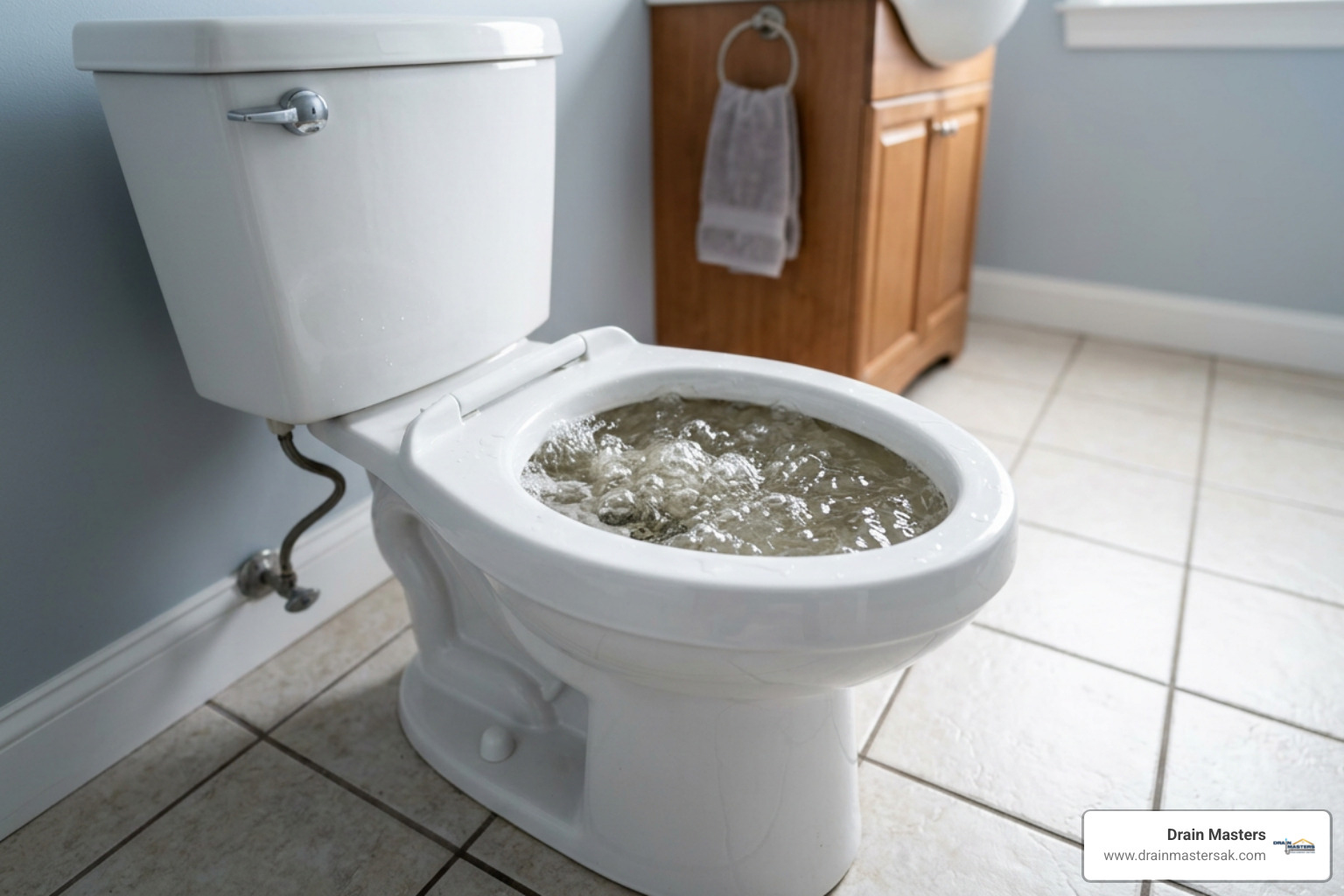
Hydro jetting gurgling toilets can fix the problem when a partial sewer-line blockage traps air and forces it back through the toilet bowl. That strange, bubbling glug sound coming from your bathroom fixture is rarely an isolated nuisance. Instead, it serves as an early warning signal from deep within your plumbing network indicating that water and air can no longer move freely through your primary drain pipes.
Understanding how your drainage network reacts to hidden restrictions is essential for keeping your home safe from sudden sewage backups:
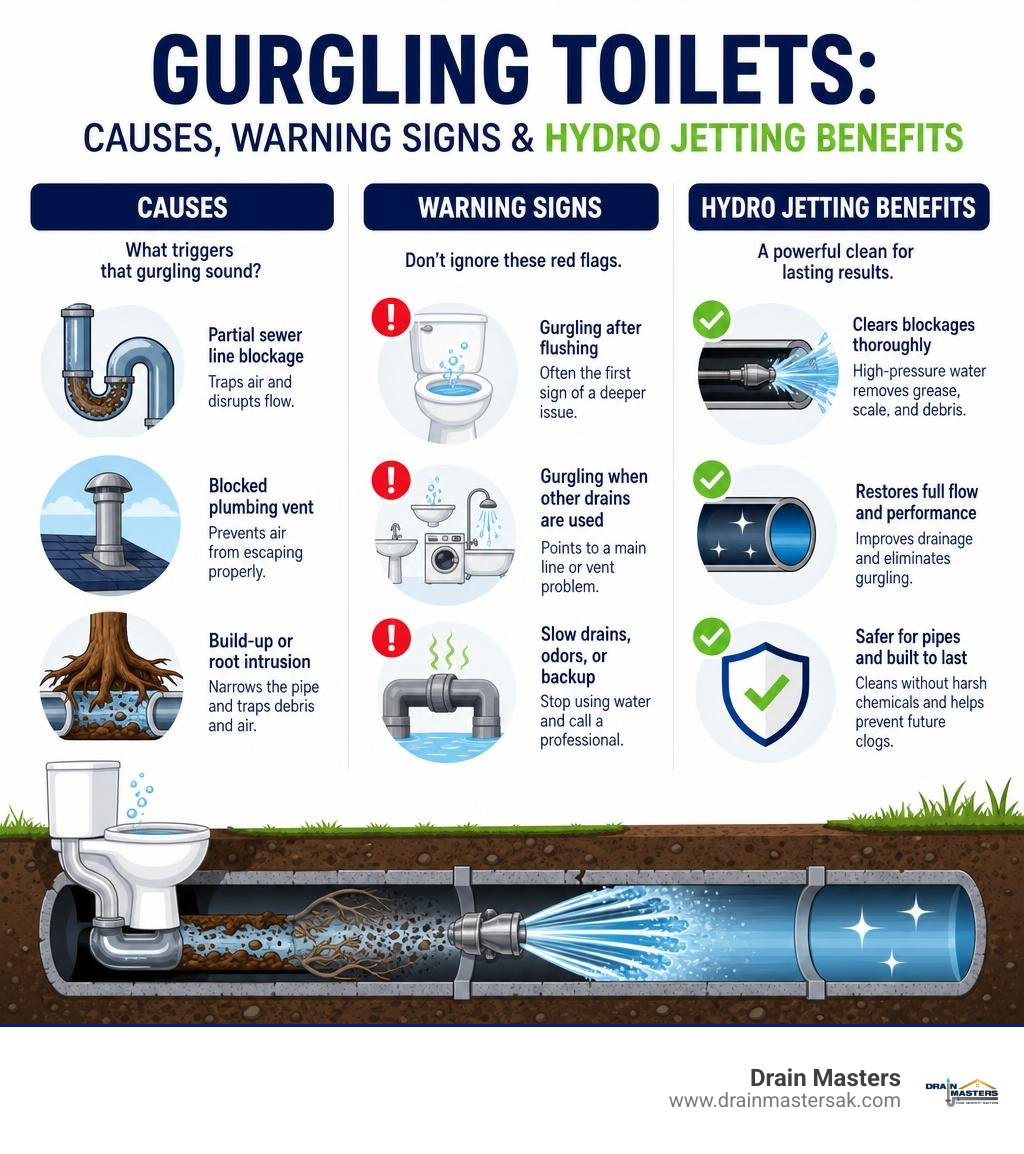
- One toilet gurgles after flushing: The localized issue may reside near the toilet fixture trap, an individual branch line, or a short section of drain pipe.
- The toilet gurgles when a shower, sink, or washer drains: A main sewer-line restriction, main lateral buildup, or a blocked plumbing vent stack is the far more probable cause.
- Gurgling comes with slow drains, sewer odors, or water backing up: You should immediately stop running water throughout the house and call a qualified professional plumbing technician without delay.
Hydro jetting utilizes highly controlled, high-pressure water streams to thoroughly scour grease, heavy mineral scale, and intrusive tree root growth from the interior walls of your sewer pipes. Unlike a traditional mechanical drain snake, which typically only punches a narrow path through an immediate clog, hydro jetting is designed to restore the full inner diameter of the line. A comprehensive sewer camera inspection should always precede jetting, especially in older Eagle River, AK residential properties, to confirm that the underground pipes are structurally sound and to identify the exact nature of the drainage blockage.
At Drain Masters, our experienced team has spent more than two decades helping homeowners and businesses in Eagle River, AK and nearby communities diagnose complex residential and commercial drain problems. This guide to hydro jetting gurgling toilets explains what those troubling plumbing noises mean, how air-pressure mechanics affect drains, and why professional high-pressure water jetting can support lasting pipe health.
Why Is My Toilet Gurgling? (Root Causes & Air Pressure Mechanics)
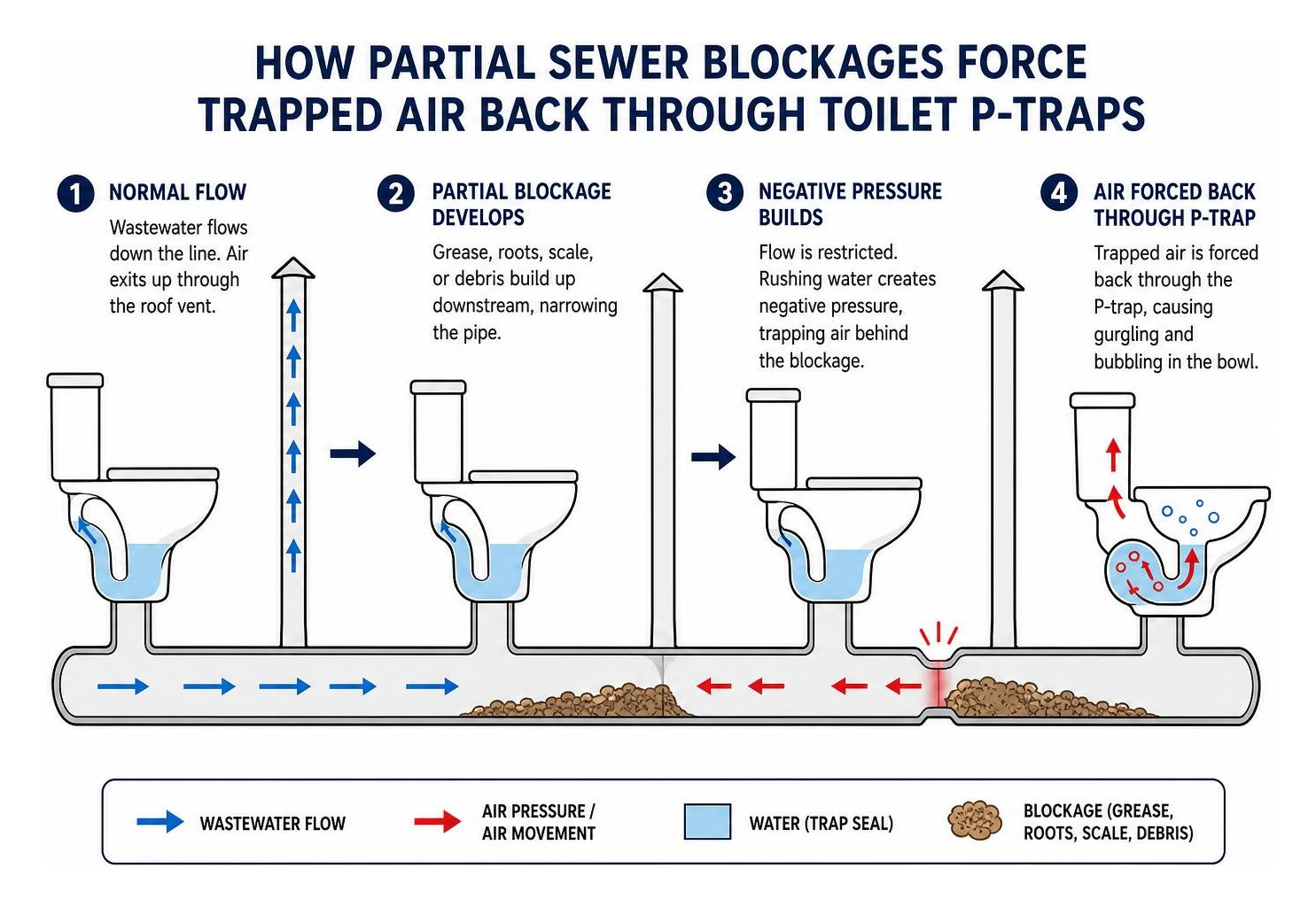
When a toilet starts making distinct glug-glug sounds or bubbling after you flush, the system is fundamentally struggling to draw air. Residential plumbing systems depend heavily on a continuous, delicate balance between wastewater moving downward and air circulating freely to relieve pressure differential. When an obstruction disrupts this flow, trapped air searches for the easiest path of least resistance to equalize atmospheric pressure. That pathway usually leads directly upward through the standing water seal in your toilet bowl.
Negative Pressure and Trapped Air in Toilet P-Traps
Every standard flushing toilet relies on an integrated S-curve or P-trap built into the ceramic body of the fixture. This specific curved channel holds a permanent reservoir of standing clean water after every flush cycle. That standing water creates a critical airtight seal that prevents foul, dangerous sewer gases from escaping into your bathroom.
Under ideal operating conditions, flushing water rushes down the waste line while displaced air escapes through your home roof vent stack. However, when a partial restriction develops further down the pipe, the descending volume of water creates a sudden vacuum effect behind it. This negative air pressure pulls air backward through the standing water seal inside the toilet trap. As those trapped air pockets burst upward through the standing water, you hear distinct gurgling sounds or witness visual bubbling inside the toilet bowl. Staying proactive by troubleshooting unusual bathroom drain noises can prevent severe main line blockages before wastewater reverses direction and causes damaging indoor flooding.
Main Line Obstructions and Blocked Vent Stacks
Toilet gurgling is seldom caused by a minor paper blockage right at the toilet outlet. More frequently, it points toward a deeper restriction within the main underground lateral sewer pipe or the broader Drain-Waste-Vent (DWV) network.
Several common issues impair airflow and cause pressure imbalance:
- Tree Root Intrusion: Underground tree roots naturally seek out moisture and nutrients, penetrating minor pipe joints, tiny cracks, or deteriorating seals. Once inside, they flourish into dense root masses that snag toilet paper, waste, and foreign debris, drastically narrowing the interior pipe space.
- Fat, Oil, and Grease (FOG) Accumulation: Cooking fats, oils, and liquid grease poured down kitchen drains cool as they travel into cooler underground pipes. Over time, these substances solidify into a sticky coating along pipe walls, gradually reducing wastewater flow capacity.
- Hard Water Mineral Scale: In municipal or well water systems containing high concentrations of calcium and magnesium, mineral deposits build up along pipe walls over years. This creates a coarse, calcified interior texture that snags passing debris and disrupts smooth air movement.
- Blocked Roof Vent Stacks: Plumbing vent stacks extend through your roof to introduce atmospheric air into the drainage network. Leaves, bird nests, snow accumulation, or ice buildup can seal these vent openings. Without proper upper ventilation, draining water creates a strong siphon that pulls air through nearby toilets and sink traps.
When multiple plumbing fixtures react simultaneously, such as a toilet bubbling while the shower drains or when the washing machine empties, a main lateral line restriction is almost certainly present. The warning signs covered in our article on identifying sewer blockages can help you recognize a developing main-line problem before it becomes an emergency.
Why Hydro Jetting Gurgling Toilets Is the Best Solution
When dealing with chronic toilet gurgling, traditional homeowner clearing methods like standard plungers or chemical drain additives prove entirely ineffective. Plungers only push standing water locally within the bowl trap, and chemical products are unable to clear heavy grease rings, dense paper masses, or thick tree root strands located dozens of feet deep in your underground lateral. Professional hydro jetting gurgling toilets treatment solves the underlying issue by thoroughly scouring the inner walls of the entire pipe run.
How Hydro Jetting Works to Clear Drain Blockages
Hydro jetting is a high-performance pipe restoration method that uses specialized equipment to pump water at controlled pressures ranging between 1,500 and 4,000 PSI directly through main drain lines.
The machinery utilizes a heavy-duty flexible hose paired with precision-engineered stainless steel nozzle attachments. As forward-facing water streams punch through dense blockages ahead, multiple rearward-facing water jets angled at 45 degrees propel the hose forward through the pipe. This rearward spray creates a powerful 360-degree scouring cone that strips away embedded grease, calcified scale, and fine root systems. All dislodged waste is safely washed downstream into the public sewer collection line or septic tank. Understanding how high-pressure water clears stubborn clogs helps explain why this advanced technique outperforms basic mechanical clearing methods.
Hydro Jetting vs. Snaking for Hydro Jetting Gurgling Toilets Issues
For decades, standard mechanical drain snaking was the go-to approach for relieving clogged lines. While a motorized rotating steel cable is capable of poking a hole through a soft localized blockage, it has significant functional limitations when addressing air displacement issues and heavy wall accumulation.
| Feature | Drain Snaking (Augering) | High-Pressure Hydro Jetting |
|---|---|---|
| Primary Action | Punches a central hole through local clog | Scours pipe walls 360 degrees clean |
| Grease & FOG Removal | Leaves thick grease coatings intact on walls | Emulsifies and flushes away all fats and oils |
| Tree Root Treatment | Tears central root core, leaving root stubs | Shears roots flush against pipe walls |
| Pipe Surface Cleaning | Minimal contact with wall scale | Removes scale and leaves inner pipe smooth |
| Prevention Longevity | Temporary relief; clogs tend to recur quickly | Long-term solution; fully restores line capacity |
| Safety Pre-Check | Manual technician feedback | Mandatory HD video camera inspection |
When a standard drain snake cable passes through a pipe coated with grease or root growth, it creates a narrow pathway through the center. However, the thick buildup left along the perimeter continues to restrict proper airflow and normal drainage. Within a short time, fresh waste catches on the remaining wall debris, and the frustrating toilet gurgle returns. Hydro jetting washes away all inner debris, completely restoring the original pipe diameter. Our explanation of why drains block repeatedly details how residual buildup can cause a clog to return after conventional cable clearing.
Diagnostic Steps: What a Pre-Jetting Camera Inspection Reveals
Before introducing high-pressure water streams into any residential plumbing system, a qualified technician must perform a detailed video sewer camera inspection. By threading a flexible, high-definition fiber-optic camera head through the sewer cleanout access, technicians obtain real-time visual footage of the entire internal pipe infrastructure.
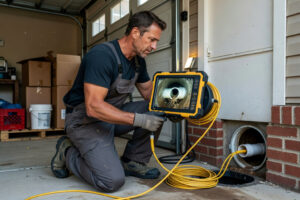
A thorough pre-jetting camera inspection delivers essential diagnostic information:
- Structural Pipe Composition and Health: The camera identifies whether the existing lines consist of PVC, ABS plastic, cast iron, or older vitrified clay tile. It detects structural vulnerabilities like longitudinal cracks, fractured sections, offset joints, or pipe collapses.
- Exact Obstruction Mapping: The inspection pinpoints the exact distance and nature of the restriction, determining whether the air blockage stems from tree root intrusions, heavy grease sludge, or foreign objects lodged in the pipe.
- Pipe Wall Condition Assessment: Visual inspection reveals whether iron pipes suffer from heavy flake rust and tuberculation or if clay pipe joints have opened up to allow root penetration.
- Safety Verification: High-pressure jetting should never be applied to structurally compromised or fully collapsed pipes. Camera verification confirms that professional hydro jetting gurgling toilets services can be safely executed without risk of damaging underground infrastructure.
In accordance with professional plumbing industry safety standards, pre-jetting video evaluations are essential to ensure the longevity of underground wastewater lines and verify that high-pressure water application is completely safe for your specific plumbing system.
Pipe Safety, Roots, and Debris Removal
A frequent concern among homeowners facing drain issues is whether high water pressure might damage underground pipes while attempting to eliminate stubborn tree roots or thick grease deposits.
Shearing Tree Roots, Grease, and Mineral Scale
Tree root invasion remains one of the primary causes of serious sewer line blockages in established neighborhoods. Seeking water and nutrient supply, roots force their way into microscopic pipe seams and joint gaps. Once inside, they spread into expansive, web-like root masses.
Hydro jetting nozzles function like high-powered underwater cutting tools. Multi-directional water jets cut through fibrous root systems, shearing them off smooth against the interior pipe wall. At the same time, high-pressure water emulsifies solidified fats, oils, and grease deposits, breaking them down into a liquid slurry that rinses cleanly out of the system. Hard water mineral deposits and heavy scale are stripped away from metallic walls, restoring a smooth internal surface that permits unrestricted air and water movement.
Is Hydro Jetting Safe for All Pipe Materials?
When administered by trained plumbing professionals following a detailed video inspection, hydro jetting is completely safe for almost all standard residential drainage systems.
- PVC and ABS Plastic Lines: Smooth, rigid plastic pipes handle standard hydro jetting pressure levels exceptionally well with zero danger of structural wall damage.
- Cast Iron Sewer Lines: Cast iron pipes in sound condition benefit significantly from jetting. High-pressure water strips away rust flaking and tuberculation, smoothing the pipe interior and restoring optimal flow.
- Vitrified Clay Pipes: Widely installed in mid-century construction, clay lines can be safely jetted provided they are structurally intact and free from major fractures or severe offsets.
- Compromised or Collapsed Lines: If video inspection detects crushed pipe walls, major structural breaks, or severe belly sags, hydro jetting is bypassed in favor of localized trenchless pipe lining or excavation repair.
What to Expect: Cost, Timeframe, and Prevention
Understanding the step-by-step procedures of professional hydro jetting helps property owners prepare when scheduling service for hydro jetting gurgling toilets.
Professional Hydro Jetting Gurgling Toilets Service Process & Timing
A standard residential hydro jetting appointment usually requires between 1 and 3 hours to complete thoroughly. The professional process follows these essential steps:
- Worksite Setup & Surface Protection: Technicians set up equipment cleanout access and lay down protective floor coverings to keep your home pristine throughout the service.
- Initial Sewer Video Inspection: A specialized camera probe is guided through the cleanout to locate the main restriction and verify structural integrity.
- High-Pressure Jetting Execution: The jetter hose is fed into the sewer access. The technician carefully regulates water pressure levels between 1,500 and 4,000 PSI based on pipe material and blockage severity, working the nozzle through the line until every trace of buildup is removed.
- Final Quality Verification Camera Run: A second video inspection is performed to verify that 100% of roots, grease, and scale have been washed away, providing visual proof of a fully restored sewer line.
Typical Costs and Long-Term Prevention Benefits
While high-pressure hydro jetting represents a specialized service investment beyond basic mechanical snaking, it offers far greater long-term value. Conventional cabling often results in repeated service calls because leftover wall debris quickly snags fresh paper and waste. A professional hydro jetting service can thoroughly clean the pipe interior, helping reduce repeat service visits and the risk of indoor sewage backups that require costly property remediation.
For ongoing preventative maintenance, residential properties benefit from scheduled hydro jetting every 2 to 3 years. Daily habits such as avoiding non-degradable wipes, paper towels, and grease down drains can help keep the system clear. Our guide to preventing recurring drain clogs offers practical maintenance steps between professional cleanings.
When to Call a Professional vs. DIY Remedies
When a toilet starts bubbling, many homeowners attempt to resolve the issue using plungers or over-the-counter chemical drain cleaners. While basic DIY steps may occasionally clear a soft, localized toilet paper plug in the fixture trap, they cannot correct deep air displacement issues originating in underground sewer mains.
Safe Homeowner Troubleshooting Steps:
- Use a high-quality flange plunger with an extended rubber sleeve, forming a firm seal inside the toilet bowl, and plunge steadily for a few minutes.
- Visually check roof vent openings from ground level using binoculars to inspect for fallen leaves, ice buildup, or bird nests obstructing upper vent paths.
- Stop running water immediately in all sinks, showers, and washing machines if you notice gurgling sounds occurring across multiple fixtures simultaneously.
Dangerous DIY Practices to Avoid:
- Avoid Chemical Drain Cleaners: Pouring harsh caustic chemicals into a gurgling toilet bowl rarely clears deep main line blockages. Chemical solutions sitting in trapped water can etch porcelain bowls, degrade rubber seals, and create hazardous chemical burn risks for technicians who must perform mechanical clearing later.
- Do Not Force Handheld Drain Snakes: Forcing rigid retail snakes through delicate ceramic toilet bowls can easily crack porcelain fixtures or get permanently wedged inside tight fixture bends.
If plunging does not quiet gurgling noises, or if bubbling coincides with foul sewer smells, slow-draining showers, or water rising in basement floor drains, stop DIY efforts immediately and contact a licensed plumbing professional. Our professional drain cleaning service can safely clear the line restriction and identify the appropriate next step.
To learn more about maintaining household plumbing health and protecting drainage systems, consult the EPA recommendations for household wastewater systems.
Frequently Asked Questions About Hydro Jetting Gurgling Toilets
Why does a gurgling toilet indicate a need for hydro jetting?
Gurgling occurs when a partial sewer line obstruction restricts airflow and water movement, forcing trapped air backward through the toilet P-trap. Hydro jetting clears the entire interior pipe diameter, removing the hidden restrictions that cause negative air pressure.
How does hydro jetting differ from snaking for toilet gurgling issues?
Snaking only punches a small hole through the center of a clog using a rotating metal cable, leaving grease, scale, and root tendrils along the pipe walls. Hydro jetting uses high-pressure water to scour pipe walls completely clean, preventing recurring air blockages.
What causes gurgling toilets that hydro jetting can fix?
Hydro jetting effectively resolves toilet gurgling caused by heavy grease accumulation, mineral scale buildup, paper debris jams, and intrusive tree root networks inside main sewer lines.
Is hydro jetting safe for all types of toilet drain pipes?
Yes, hydro jetting is safe for PVC, ABS, cast iron, and sound clay pipes when preceded by a professional video camera inspection to confirm the pipe is structurally intact.
How does hydro jetting remove tree roots, grease, and mineral scale from toilet drains?
Specialized steel nozzles spray multi-directional water jets at 1,500 to 4,000 PSI. Forward jets break apart solid obstacles, while rearward jets shear tree roots flush at pipe walls and emulsify stubborn grease into a liquid slurry.
What is the typical cost of hydro jetting for a gurgling toilet?
Service costs vary based on pipe length, diameter, obstruction severity, and access point location. Hydro jetting costs slightly more than a standard drain snake call, but provides far longer-lasting results and prevents expensive sewage backups.
How long does a hydro jetting service take for a residential toilet drain?
A standard residential hydro jetting appointment usually takes between 1 and 3 hours, which includes initial site setup, a pre-jetting video camera inspection, line scouring, and a final verification camera run.
Can hydro jetting prevent future gurgling and backups?
Yes. By stripping pipe walls completely bare and restoring the original internal pipe diameter, hydro jetting removes the anchor points where waste and paper catch, delivering long-term protection against future gurgling and backups.
When should a homeowner call a professional for hydro jetting instead of DIY methods?
Homeowners should call a professional if plunging fails to quiet the noise, if multiple fixtures gurgle simultaneously, or if gurgling is accompanied by sewer odors, slow drains, or water backing up into showers or floor drains.
What does a pre-jetting camera inspection reveal about the cause of gurgling?
A pre-jetting video camera inspection pinpoints the exact location and nature of the obstruction (roots, grease, scale) and verifies the structural condition of the pipe to ensure high-pressure water can be used safely.
Conclusion
A gurgling toilet should never be dismissed as a minor inconvenience. That distinct bubbling noise serves as a clear warning sign from your drainage network that trapped air and wastewater are struggling to pass through a restricted pipe line. While standard plungers might offer brief temporary relief, lasting comfort requires thoroughly clearing the wall-to-wall grease deposits, mineral scale, or intrusive root growth that restrict your main sewer line.
At Drain Masters, our family-owned team brings more than two decades of plumbing expertise to residential and commercial properties throughout Eagle River, AK. With video sewer camera diagnostics and advanced high-pressure water jetting, we help resolve challenging pipe restrictions. If your bathroom fixtures are gurgling or draining slowly, contact our professional hydro jetting technicians to protect your plumbing system and restore reliable flow.