
When Your Pipes Are the Problem: What Every Homeowner Should Know About Repiping
Plumbing repiping services are the process of replacing a home’s existing water supply pipes with new ones, typically because the old pipes have corroded, degraded, or failed beyond the point of simple repair.
Here is a quick overview of what repiping involves and when you need it:
| Question | Quick Answer |
|---|---|
| What is repiping? | Replacing old or failing water supply pipes throughout your home |
| When do you need it? | Frequent leaks, low water pressure, discolored water, or pipes over 30 years old |
| Common materials used | Copper, PEX, and CPVC |
| How long does it take? | Most homes are completed in 2 to 4 days |
| What does it cost? | Pricing varies depending on home size, pipe material, and accessibility |
If your home has aging pipes, you have probably noticed the warning signs already. Water that comes out brown or rust-colored. Pressure that has slowly gotten worse over the years. A leak that gets fixed, only for another one to show up a few months later. These are not random inconveniences. They are signs that your plumbing system is breaking down from the inside out.
Homes built before the 1980s often have galvanized steel pipes that corrode from within over time. Some homes from that era also contain polybutylene or even lead pipes, both of which carry serious risks to water quality and structural reliability. At a certain point, patching the same failing system over and over stops making sense.
That is when full repiping becomes the smarter, safer choice.
In Anchorage, AK, older homes face an added challenge. Freezing temperatures put extra stress on pipes every winter, accelerating wear on materials that were never designed to last indefinitely. What might be a slow decline in a milder climate can become a rapid failure here.
I am Debra Blouin, General Manager of Drain Masters Anchorage, and with over two decades of hands-on experience in the plumbing industry, I have helped countless Anchorage homeowners navigate decisions around plumbing repiping services and understand when a full repipe is the right call. In this guide, I will walk you through everything you need to know, from recognizing the signs to choosing the right materials and knowing what to expect during the process.
What is Repiping and When Should You Choose It Over Repairs?
To understand whether your home requires a complete plumbing overhaul, it is helpful to first define what the process actually looks like. Many homeowners assume that a plumbing issue always warrants a quick patch. However, there is a distinct line between fixing a localized problem and addressing a systemic failure.
When we talk about pipe replacement, we are looking at the health of your entire network. Over decades, the pipes carrying hot and cold water to your kitchen, bathrooms, and laundry room undergo constant wear. Mineral deposits build up, chemical reactions corrode the metal, and joints weaken. When this happens, a single leak is rarely an isolated incident. It is often the first symptom of a total system failure.
We always start by assessing whether getting professional plumbing repairs done can solve the issue. If a modern pipe was accidentally punctured during a renovation, or if a single fitting loosened, a quick repair is the most logical and cost-effective solution. Our team can perform targeted leak mitigation, swap out a small section of pipe, and restore your system to perfect working order.
However, if your pipes have reached the end of their natural lifespan, continuous patching is like putting a small bandage on a major structural crack. The average lifespan of residential pipes varies. Galvanized steel often begins to fail after forty years, while copper can last around fifty years under ideal conditions. When these systems age out, the rate of leaks increases rapidly. Choosing a full repipe over endless minor repairs protects your home from sudden, catastrophic water damage and saves you from the ongoing headache of calling a plumber every few months.
Understanding Whole-House Plumbing Repiping Services
A whole-house repipe is a comprehensive plumbing project that involves replacing every single water supply line in your home. This means we run brand-new hot and cold water lines from the main water source where it enters your home, routing them all the way to your sinks, toilets, showers, tubs, and appliances.
This is a highly coordinated, systematic upgrade. We do not just pull random pipes out of the walls. Instead, we carefully map out your home’s layout to find the most efficient pathways for the new lines. By choosing to invest in comprehensive plumbing repiping, you are completely resetting the clock on your home’s plumbing. You get a modern, reliable system that meets current building codes, delivers clean water, and operates under proper pressure without the constant threat of pinhole leaks.
When Spot Repairs Are No Longer Enough
It can be tempting to opt for spot repairs to save money in the short term. However, the costs of frequent repairs accumulate quickly. If you find yourself calling a plumber multiple times a year to fix new leaks, you are spending money on temporary fixes that do not solve the underlying problem.
Think of your plumbing system as an old garden hose. Once the rubber gets dry and brittle, patching one hole just increases the pressure on the next weakest spot, causing a new leak to spring nearby. Staying on top of preventive plumbing maintenance is excellent for keeping a healthy system in top shape, but it cannot reverse decades of metal corrosion or chemical degradation. When the structural integrity of your pipes is compromised, investing in a whole-house repipe is the only way to secure your home and put an end to the compounding expenses of emergency plumber visits.
Key Signs Your Home Needs Professional Plumbing Repiping Services
Recognizing when your plumbing system is in trouble can save you from waking up to a flooded basement or a ruined ceiling. Because most of your pipes are hidden behind drywall, under floorboards, or in crawlspaces, you have to rely on indirect clues to assess their condition.

Here are the most common warning signs that indicate your home is a candidate for professional plumbing repiping services:
- Frequent, recurring leaks: If you are dealing with multiple leaks in different areas of your home within a short timeframe, your pipes are telling you they have reached their limit.
- Persistent low water pressure: Over time, rust and mineral scale build up inside older pipes, narrowing the passage for water. If your shower has turned into a weak trickle, clogged pipes are likely the culprit.
- Discolored or rusty water: If your tap water looks yellow, brown, or reddish, especially after not being used for a few hours, the interior of your iron or galvanized pipes is actively rusting away.
- A metallic taste or odor: Corroding metal pipes leach iron and other minerals into your drinking water, altering its taste and smell.
- Flakes of rust or sediment in the water: If you notice small dark particles clogging your faucet aerators or showerheads, your pipes are physically disintegrating.
- Noisy pipes: Bubbling, whistling, creaking, or loud banging sounds (known as water hammer) often indicate that older pipes are struggling with pressure fluctuations or have loose supports.
- Visible corrosion on exposed pipes: Take a look at the pipes in your basement, crawlspace, or utility closet. If you see greenish stains on copper, or white, powdery, or flaky buildup on galvanized steel, corrosion is well underway.
Red Flags in Older Plumbing Systems
If your home was built several decades ago, it may contain piping materials that are now known to be hazardous or highly prone to failure. Galvanized steel pipes, which were common in homes built before the 1970s, are notorious for rusting from the inside out. This internal rust not only restricts water flow but also traps contaminants, degrading your water quality.
Even more concerning is the presence of lead pipes or lead solder, which pose severe health risks, particularly to children and pregnant women. Lead can leach directly into your drinking water, causing neurological and developmental issues.
Another major red flag is polybutylene piping. Popular from the late 1970s through the mid-1990s, this flexible plastic pipe was hailed as a cheap, easy-to-install alternative to copper. However, it was later discovered that common water-treatment chemicals, like chlorine, cause polybutylene to become brittle and crack from the inside, leading to sudden, catastrophic pipe bursts. If your home has any of these outdated materials, prioritizing taking care of your aging home plumbing and planning a plumbing repipe is essential for your family’s safety and peace of mind.
Comparing Modern Pipe Materials: Copper, PEX, and CPVC
When you decide to repipe your home, one of the most important decisions you will make is selecting the new piping material. Modern plumbing relies primarily on three materials, each offering distinct advantages depending on your budget, home layout, and local climate.
To help you understand your options, we have compiled a quick comparison of the three most popular materials used to meet established national repiping standards:
| Material | Expected Lifespan | Key Pros | Key Cons | Best Suited For |
|---|---|---|---|---|
| Copper (Type L) | 50+ Years | Extremely durable, naturally antimicrobial, fire-resistant, cannot leach chemicals | Higher material cost, rigid (requires more joints), susceptible to acidic water | High-end homes, exposed piping, areas with strict local codes |
| PEX (Cross-linked Polyethylene) | 50+ Years | Highly flexible, freeze-resistant, cost-effective, faster installation, fewer fittings | Cannot be used outdoors (UV sensitive), cannot be directly connected to water heaters | Most residential whole-house repiping projects |
| CPVC (Chlorinated Polyvinyl Chloride) | 40 to 50 Years | Budget-friendly, handles high temperatures, easy to install, resistant to corrosion | Can become brittle over time, rigid, prone to cracking during extreme freeze-thaw cycles | Budget-conscious repipes, localized hot-water line replacements |
The Pros and Cons of Copper Piping
Copper piping has been the gold standard of plumbing materials for decades, and for good reason. It is incredibly durable, capable of lasting fifty years or more under normal conditions. Because copper is a natural element, it is completely non-toxic and has natural antimicrobial properties, meaning it actively resists the growth of bacteria inside your water lines. It is also highly resistant to fire and will not melt or release toxic gases in a house fire.
However, copper is not without its drawbacks. The material cost of copper is significantly higher than plastic alternatives, which can increase the overall cost of your project. Because copper is rigid, installing it requires cutting, dry-fitting, and soldering numerous joints to navigate the corners and walls of your home. This labor-intensive process adds to the installation timeline. Additionally, if your water has a low pH (acidic water), it can cause copper to corrode prematurely, leading to pinhole leaks.
Why PEX is a Game-Changer for Plumbing Repiping Services
PEX tubing, or cross-linked polyethylene, has revolutionized the residential plumbing industry. This flexible, high-density plastic tubing offers a range of benefits that make it the preferred choice for most modern repiping projects.
Its primary advantage is flexibility. Because PEX can bend around corners and snake through tight wall cavities without the need for elbow fittings, we can install long, continuous runs of pipe from a central manifold directly to your fixtures. Fewer fittings mean fewer potential leak points, making the entire system much more secure.
For homeowners in Anchorage, AK, PEX offers a crucial benefit: freeze resistance. Because the material is flexible, it can expand slightly if water freezes inside it, making it much less likely to burst during our harsh winters compared to rigid copper or CPVC. Furthermore, PEX is highly resistant to scale buildup and corrosion, does not transfer heat as quickly as copper (which saves energy on hot water), and is much faster and more cost-effective to install.
The Repiping Process: Timeline, Cost Factors, and Minimizing Disruption
The thought of replacing all the pipes in your home can feel overwhelming. Many homeowners worry that their walls will be completely torn down, their water will be shut off for weeks, and their lives will be thrown into chaos. Fortunately, modern plumbing techniques and experienced crews make the process incredibly efficient and minimally disruptive.
What to Expect During a Whole-House Repipe
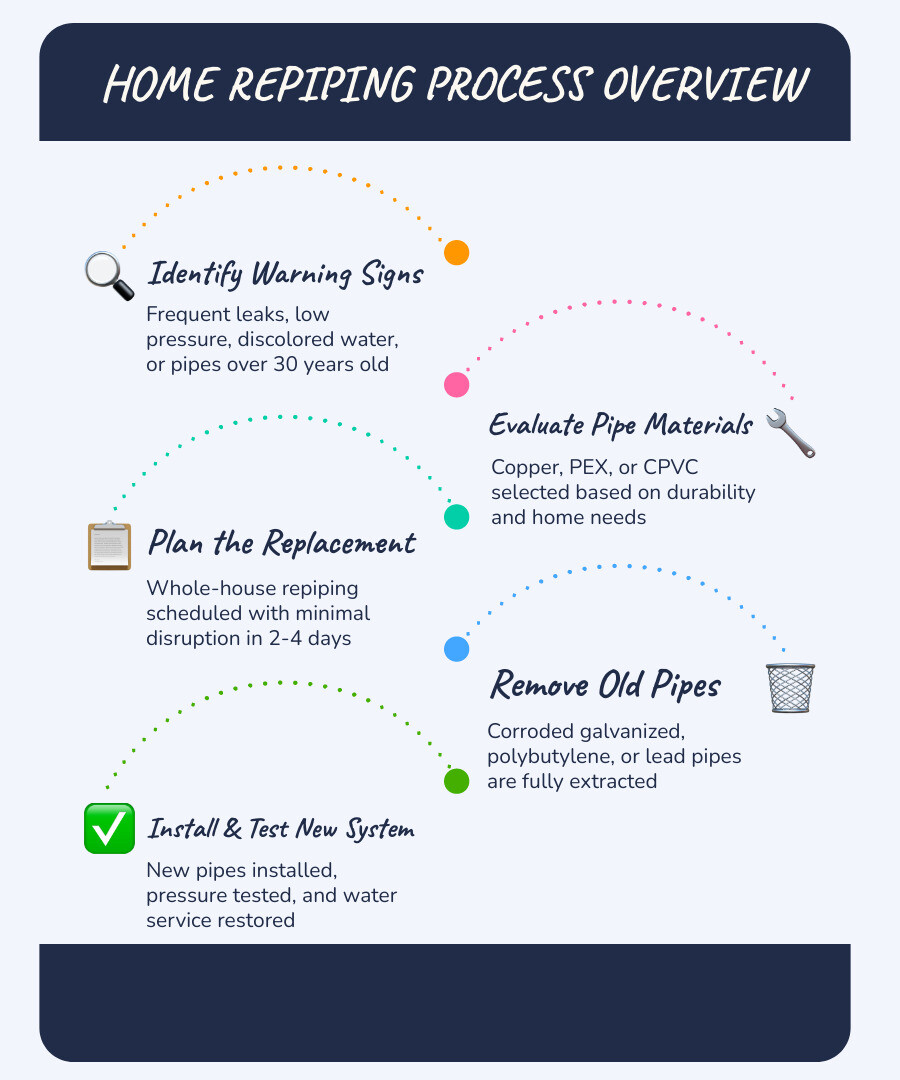
A typical whole-house repiping project follows a structured, step-by-step process designed to keep your home clean and functional:
- Preparation and Protection: Before any work begins, our crew covers your floors, furniture, and personal belongings with drop cloths and protective plastic. We treat your home with the utmost respect, ensuring we leave no trace of mess behind.
- Locating and Mapping: We identify the locations of your existing pipes and map out the most efficient routes for the new water lines.
- Strategic Access Cuts: Instead of tearing down entire walls, we make small, precise access cuts in your drywall, usually measuring about twelve by twelve inches. We place these cuts in inconspicuous locations, such as inside closets or behind cabinets, whenever possible.
- Running the New Lines: We feed the new PEX or copper lines through your walls, floors, and ceilings, bypassing the old, failing system.
- Connection and Integration: We connect the new lines to your fixtures, valves, and water heater.
- Pressure Testing and Inspection: Once the installation is complete, we run a rigorous pressure test to ensure there are absolutely no leaks. We then coordinate with local city inspectors to verify that all work meets local building codes.
- Drywall Patching and Cleanup: After the system is approved, we professionally handle the drywall patching, texturing, and painting of the cuts, returning your walls to their original condition. Finally, we perform a deep clean of the work areas.
Most whole-house repipes can be completed in just two to four days. Best of all, we do not leave you without water overnight. We only shut off your water service for a few hours during the day while we are actively working, and we restore water service to your home at the end of every workday so your family can shower, cook, and use the restroom.
If your main water line or sewer line is also showing signs of age, we can discuss exploring trenchless pipe repair options to replace those outdoor lines with minimal excavation, preserving your beautiful landscaping and driveway.
Factors That Influence the Overall Cost
When planning a repipe, it is important to understand that pricing can vary depending on several factors. Because every home is built differently, there is no one-size-fits-all cost for a repiping project.
The primary factors that will influence your estimate include:
- The size of your home: Larger, multi-story homes require more pipe and labor than single-story homes.
- The number of plumbing fixtures: Every sink, toilet, shower, tub, washing machine, and outdoor hose bib adds to the complexity and material requirements of the project.
- The piping material you choose: PEX is generally more budget-friendly due to lower material costs and faster installation times, while copper is a more significant investment.
- Accessibility: Homes with open basements, crawlspaces, or easily accessible attics require less drywall cutting and labor, whereas homes built on concrete slabs or with tight wall cavities can be more challenging to work on.
- The complexity of your home’s layout: Multiple bathrooms spread across different wings of a house require more routing and connections than a stacked layout where bathrooms are aligned vertically.
Frequently Asked Questions About Home Repiping
How long does a whole-house repiping project take?
For an average-sized home with two bathrooms, a professional whole-house repipe typically takes between two and four days to complete. This timeline includes running the new lines, connecting the fixtures, pressure testing, city inspections, and patching the drywall.
What is the difference between partial and whole-house repiping?
Partial repiping involves replacing only a specific section of your plumbing system, such as a damaged line in your basement or the hot-water lines. Whole-house repiping replaces every water supply pipe from the main shut-off valve to every fixture in your home. While partial repiping can address an immediate issue, whole-house repiping is the only way to permanently solve systemic corrosion and leak problems.
Are there health risks associated with older galvanized or lead pipes?
Yes, older pipes can pose serious health risks. Lead pipes and lead solder can leach lead into your drinking water, which is a potent neurotoxin. Galvanized steel pipes corrode internally, releasing rust, iron, and potentially trapping harmful bacteria and heavy metals in your water supply.
Will repiping my home improve my water pressure?
Absolutely. Over time, rust and mineral scale restrict the inside diameter of older pipes, severely reducing water flow. Replacing these clogged pipes with smooth, modern PEX or copper lines restores your system’s proper flow rate and brings your water pressure back to optimal levels.
How do plumbers avoid tearing down all my walls during installation?
Experienced plumbers use a technique called bypass routing. By making small, strategic access cuts in your drywall (often inside closets or utility areas), we can feed flexible PEX tubing through your existing wall cavities, minimizing the need to open up large sections of your walls.
What is the average lifespan of PEX versus copper pipes?
Both PEX and copper are highly durable materials. Copper pipes typically last fifty years or more under ideal conditions, while PEX is also designed to last fifty years or more. The actual lifespan of both materials can be influenced by water chemistry, water pressure, and local environmental factors.
Does homeowners insurance cover the cost of repiping?
In most cases, homeowners insurance does not cover the cost of preventive repiping, as they view pipe wear and tear as a maintenance responsibility. However, if a sudden, accidental pipe burst causes water damage, insurance may cover the cost of repairing the water damage, but they still rarely cover the cost of replacing the actual plumbing system.
Can I live in my home while the repiping work is being done?
Yes, most homeowners remain in their homes during a repiping project. Our team works systematically to ensure your water is only turned off during the day while we are actively working. We restore your water service every evening so you can maintain your normal routine.
What kind of warranties are typically offered with repiping services?
Reputable plumbing companies offer robust warranties to protect your investment. This typically includes a manufacturer warranty on the piping materials (often twenty-five years for PEX) and a workmanship guarantee from the plumbing company covering the installation labor.
How do I know if my sewer line also needs to be replaced?
If you are experiencing frequent drain backups, slow drains throughout your home, gurgling toilets, or sewer odors in your yard, your sewer line may be failing. We recommend looking for sewer line replacement indicators and scheduling a video camera inspection to assess the health of your waste lines alongside your water lines.
Conclusion
Investing in plumbing repiping services is one of the most significant upgrades you can make for your home. It goes far beyond simply stopping a leak; it is about restoring the fundamental safety, comfort, and value of your property. By replacing old, corroding, or hazardous pipes with modern materials like copper or PEX, you ensure that your family has access to clean, rust-free water and robust water pressure for decades to come.
While the scale of a whole-house repipe can sound intimidating, working with an experienced, professional team makes all the difference. At Drain Masters, we bring over twenty years of local expertise, upfront pricing, and advanced tools to every project, ensuring your repipe is completed quickly, cleanly, and with minimal disruption to your daily life.
Whether you need fast plumbing repairs, seasonal maintenance, or a complete system replacement, the dedicated team at Drain Masters is ready to help. Please contact us today to schedule professional repiping with our team and secure your home’s plumbing system for the future.