
Why a Broken Clay Sewer Pipe Fails in Older Homes
To fix a broken clay sewer pipe, homeowners typically rely on one of several proven methods: splicing in a new section of PVC using shielded transition couplings for isolated damage, applying cured-in-place pipe (CIPP) epoxy lining for cracked lines, or utilizing trenchless pipe bursting to pull seamless HDPE pipe through collapsed sections. When severe ground collapse or pipe bellies occur, a full open-trench replacement is necessary to restore proper drainage pitch.
Clay sewer pipes, technically known as vitrified clay pipe (VCP), were the gold standard of residential wastewater infrastructure throughout the twentieth century. In homes built prior to the 1980s, underground sewer lines were almost exclusively laid using these ceramic segments before modern plastics took over the market.
While the material itself boasts incredible longevity, the way these lines were engineered and assembled creates distinct structural vulnerabilities over time. Installers laid clay lines in short lengths ranging from two to five feet, connecting them with bell-and-spigot joints. Decades ago, technicians sealed these connections with oakum (tarred hemp rope) and poured concrete mortar. As decades pass, natural ground settling, ambient moisture, and changing underground pressures cause this rigid mortar to crack, crumble, and wash away, leaving open gaps at every single joint along your lateral.
Historical Use and Lifespan of Vitrified Clay
Vitrified clay is produced by shaping natural clay, drying it, and firing it inside kilns at temperatures exceeding 2,000°F. This extreme heat vitrifies the clay, fusing the minerals into an inert, glass-like, non-porous ceramic. Because of this composition, clay provides exceptional chemical durability. It does not rust like cast iron, nor does it corrode from harsh sewer gases or household chemicals.
Under ideal conditions, vitrified clay drainage pipe carries a structural lifespan of 50 to 100 years. However, the fundamental weakness of clay is its material brittleness. Unlike flexible modern plastics, clay cannot bend or absorb ground movement. When surrounding soils shift, the short segments easily experience joint shear, offset displacement, or longitudinal fractures.
Top Symptoms of a Broken Clay Sewer Pipe in Your Yard
Because sewer lines are buried deep underground, physical breaks often manifest through subtle household disruptions before escalating into a disastrous basement backup. Recognizing early warning indicators allows you to intervene before wastewater floods your living spaces:
- Frequent Plumbing Backups: Wastewater backing up into lower-level tubs, showers, or floor drains whenever high-volume appliances (like washing machines) drain.
- Persistent Gurgling Sounds: Toilets bubbling or gurgling when sinks drain, indicating trapped sewer air caused by line restrictions.
- Foul Sewer Gas Odors: Hydrogen sulfide smells wafting from floor drains, basement corners, or specific areas of your yard caused by escaping gases from cracked subterranean pipes.
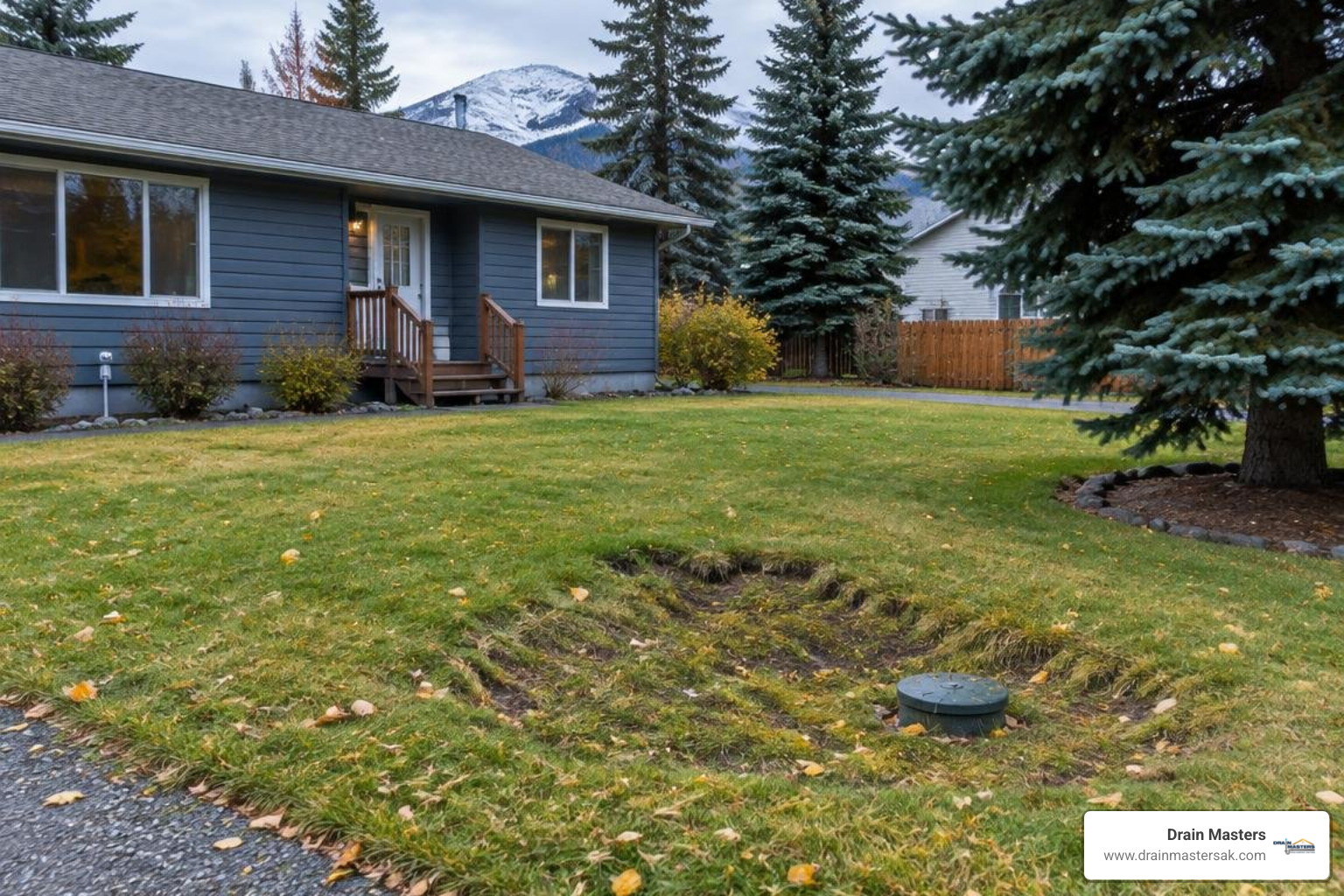
- Lush, Overgrown Grass Patches: An abnormally vibrant, fast-growing strip of green grass tracing the path of your buried sewer lateral, fed by nutrient-rich wastewater escaping cracked joints.
- Lawn Sinkholes and Depressions: Soil depressions or soggy sinkholes forming in your yard where escaping sewage has eroded the subterranean dirt supporting the surface.
Diagnosing Sewer Line Damage Before Digging
Tackling an underground sewer failure without diagnostic imaging is like performing surgery in the dark. Before anyone unholsters a shovel or brings heavy excavation machinery onto your property, an exact assessment of the pipe’s condition, depth, and spatial orientation is mandatory. Proper diagnostic steps assist homeowners in evaluating whether a line requires spot repairs or full replacement without unnecessary property destruction.
Conducting a Diagnostic Sewer Camera Inspection
The most accurate method for inspecting underground plumbing is an advanced sewer camera inspection. A technician feeds a specialized, lighted waterproof camera attached to a rigid push-rod directly into the cleanout or main drain stack.
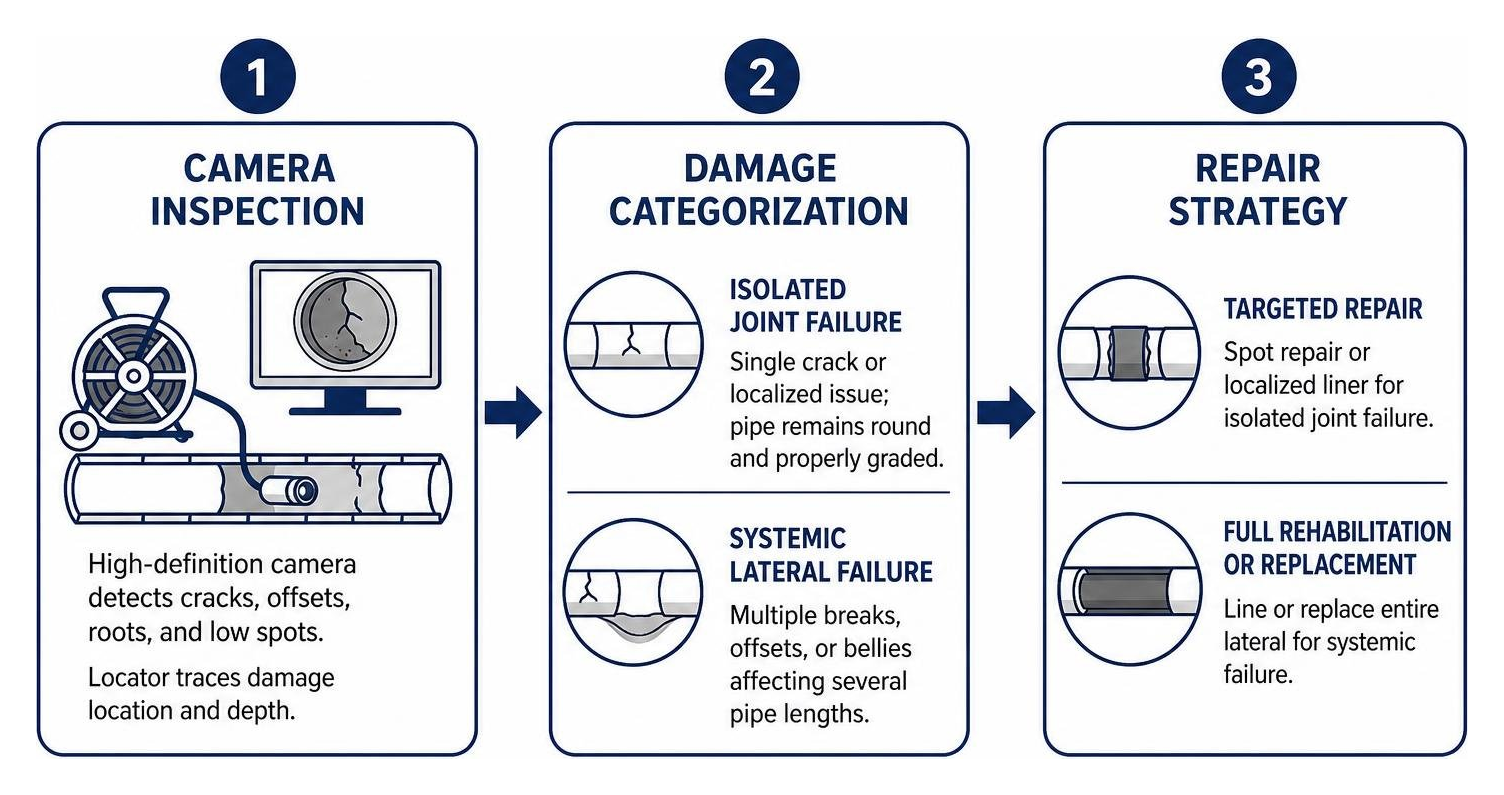
As the camera travels through the pipe, it broadcasts real-time video to an external monitor, pinpointing structural cracks, joint offsets, root intrusion balls, and low spots. Modern camera systems feature an integrated 512 Hz sonde transmitter. By waving an electronic locator wand along the surface of your yard, the technician can trace the camera head above ground, recording the exact depth and physical location of the damage down to the inch. Diagnostic video footage provides clear visual verification of subterranean defects, ensuring that no unnecessary areas of your lawn, driveway, or patio are excavated.
Differentiating Isolated Joint Cracks from Systemic Failure
Not every damaged clay pipe requires digging up your entire yard. Diagnostic footage allows professionals to categorize the damage into two distinct structural profiles:
- Isolated Joint Failure: A single cracked collar, localized hairline fracture, or isolated root penetration point where the remainder of the upstream and downstream pipe maintains its round shape, proper grade, and clean joints. These scenarios are excellent candidates for targeted spot repairs or localized sectional liners.
- Systemic Lateral Failure: Multiple collapsed sections, widespread structural fractures spanning several pipe lengths, extensive joint offsets, or severe bellies (low spots that hold standing water). Reviewing the long-term performance of sectional drain patch liners helps clarify why patching one section of a crumbling, multi-joint clay lateral is often a temporary fix compared to rehabilitating the entire run.
5 Proven Solutions to Fix or Replace Damaged Clay Lines
Fixing an underground sewer line requires strict adherence to excavation safety, municipal building codes, and plumbing dynamics. Before beginning any physical repair, you must assemble the correct tools and prepare the site:
- Essential Safety and Digging Gear: Call 811 to locate underground gas, electrical, and water utilities. Gather personal protective equipment (heavy boots, eye protection, heavy-duty rubber gloves), trench shoring if digging deeper than four feet, and a submersible utility pump to manage standing gray water.
- Precision Cutting Tools: A heavy-duty chain snap cutter or an angle grinder fitted with a diamond masonry blade.
- Bedding Materials: Clean, washed pea gravel or coarse drainage sand to bed the pipe and prevent post-installation settling.
- Replacement Fittings: Code-approved, stainless steel shielded flexible couplings rated for clay-to-plastic transitions and Schedule 40 or SDR 35 PVC pipe.
Splicing Out a Broken Clay Sewer Pipe Section with PVC
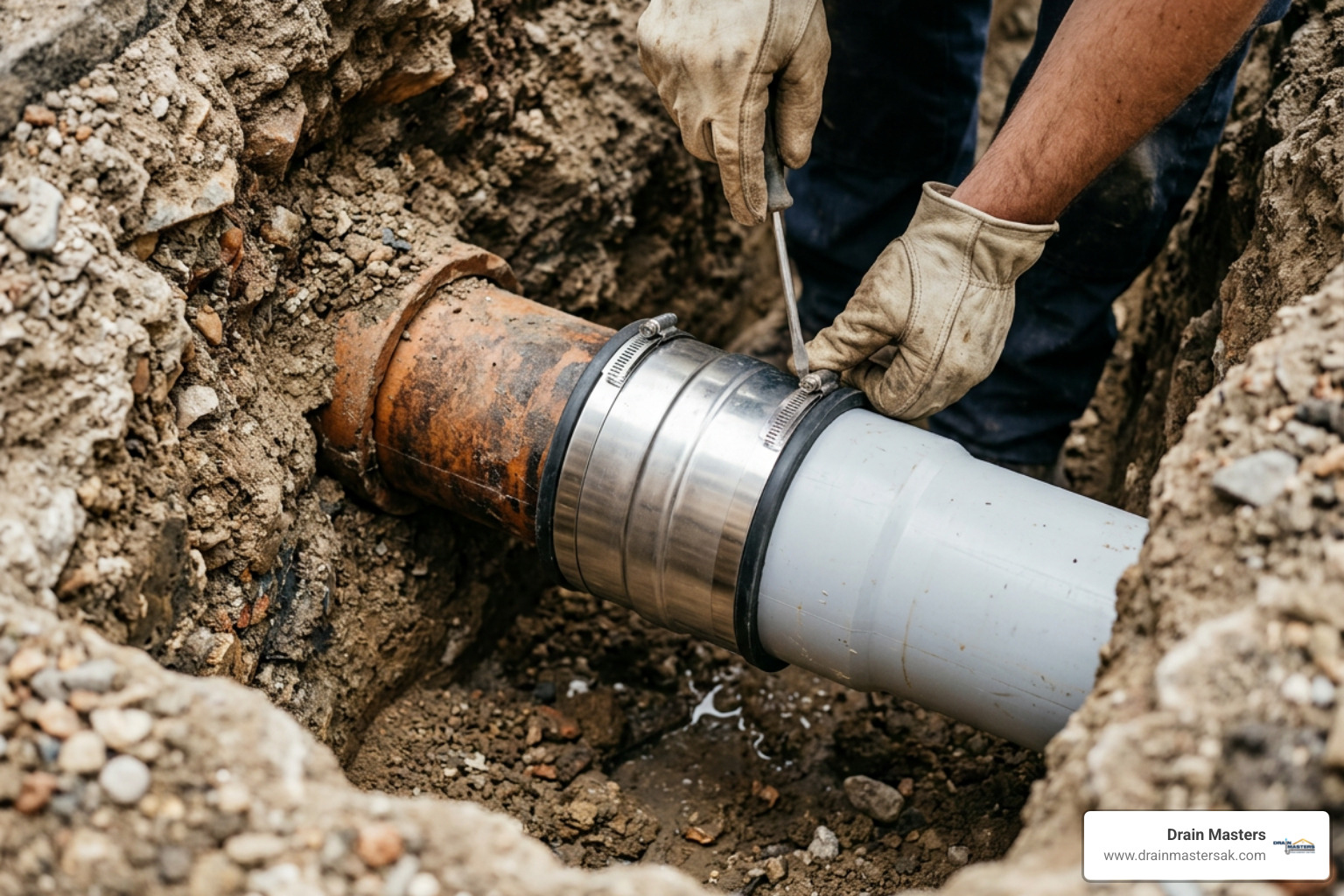
When diagnostic footage reveals that structural damage is confined to a single, easily accessible section of clay pipe, executing a physical splice using modern plastic pipe provides a permanent, code-compliant fix. Understanding precise mechanical connections ensures proper transitions when joining dissimilar piping materials.
Follow this step-by-step process to splice out a failed section:
- Excavate the Work Area: Dig down to expose the damaged clay pipe, creating at least 12 inches of lateral clearance on all sides and a minimum of 6 inches of open space directly beneath the pipe. Dig a small catchment pit beneath the cut zone to catch loose debris and gray water.
- Clean the Pipe Exterior: Use a stiff wire brush and clean water to scrub all soil, scale, and mineral deposits off the exterior clay surfaces at the intended cut locations. The clay must be smooth and clean for mechanical couplings to seal properly.
- Square-Cut the Clay Pipe: Wrap a chain-style snap cutter around the pipe at least 6 to 12 inches away from the damaged area on solid, uncracked clay. Ratchet the cutter until the chain applies even circumferential pressure, snapping the pipe cleanly without shattering it. If using an angle grinder with a diamond blade, score the entire outer diameter before completing the cut through the wall.
- Measure and Cut the PVC Bridge: Measure the exact distance between the two clean clay cut ends. Cut a section of Schedule 40 or SDR 35 PVC pipe, subtracting 1/2 inch total (1/4 inch per side) to accommodate mechanical stops and allow for thermal expansion.
- Install Shielded Flexible Couplings: Slide specialized, stainless steel shielded transition couplings over each clay pipe end. These are distinct from unshielded rubber boots; their heavy-gauge stainless steel outer sleeve prevents shear failure when surrounding soil shifts.
- Set the Bridge and Torque Bands: Insert the PVC bridge pipe into position. Slide the rubber sleeves and steel shear bands over the transition joints so they sit evenly over both the clay and PVC. Using a calibrated torque wrench, tighten the stainless steel band worm clamps to exactly 60 inch-pounds according to manufacturer specifications.
- Verify Slope and Bed the Pipe: Place a torpedo level on the new PVC bridge to confirm the line maintains a minimum downward slope of 1/4 inch per linear foot. Pack 6 inches of washed crushed rock or pea gravel underneath and around the pipe before backfilling soil to eliminate point loading.
While localized digging is technically possible for experienced property owners, excavating trenches carries inherent collapse hazards, hazardous wastewater exposure, and municipal permitting requirements. Property owners should always prioritize safety and contact a licensed team for sewer clearing, cleaning, and repair before undertaking underground sewer work.
Applying Cured-in-Place Pipe (CIPP) Lining
For cracked, aging, or root-invaded clay lines where digging up finished landscape, paved driveways, or patios is impractical, cured-in-place pipe (CIPP) lining offers an advanced trenchless rehabilitation method.
During the cured-in-place pipe lining process, technicians insert an epoxy-saturated felt tube directly into the damaged clay lateral through an existing outdoor cleanout. Using compressed air or water inversion, the liner inflates against the interior walls of the old clay pipe, filling every hairline fracture and sealing all vulnerable joint seams. Once cured using ambient air, hot water, or UV light, the epoxy hardens into a seamless, joint-free, structural pipe within a pipe.
Homeowners facing complex lateral runs often explore trenchless sewer lateral repair because it restores full hydraulic capacity with a long structural service life without disturbing mature trees or expensive hardscaping.
Utilizing Pipe Bursting for Trenchless Full Replacement
When an underground clay lateral has suffered widespread structural cracking, partial wall collapses, or severe joint displacement that makes lining impossible, pipe bursting provides a powerful trenchless replacement solution.
Pipe bursting requires excavating two small access pits: an insertion pit near the home and a receiving pit near the municipal main or property boundary. Technicians pull heavy steel pulling rods through the interior of the old clay lateral. Attached to the rods is an expanding, bullet-shaped steel bursting head connected directly to a continuous length of heat-fused High-Density Polyethylene (HDPE) pipe.
As a high-powered hydraulic pulling unit pulls the bursting head through the subterranean lateral, the head fractures the brittle clay pipe, pushing the shattered fragments outward into the surrounding soil. Simultaneously, it pulls the new, seamless HDPE pipe into the exact void left behind.
Executing a Code-Compliant Open-Trench Lateral Replacement
When an aging clay sewer line suffers from a severe structural belly (a sagging dip where gravity flow ceases), significant grade failure, or complete soil collapse, open-trench excavation is mandatory. Trenchless lining and pipe bursting follow the existing path of the old pipe, meaning they cannot correct severe dips or grade errors.
Executing traditional open-trench sewer repair involves using a backhoe or mini-excavator to dig a continuous trench along the entire length of the lateral from the home’s foundation to the municipal sewer tie-in.
Proper bedding and mechanical compaction prevent subsequent soil settling, ensuring that the new smooth-wall PVC line delivers decades of trouble-free wastewater conveyance.
Implementing Preventative Root Barriers and Jetting Maintenance
If diagnostic cameras show that your vitrified clay pipe remains structurally round with only minor hairline fractures and weeping joints, you can manage the line through a proactive maintenance program to forestall structural failure:
- Hydro-Jetting: High-pressure water jetting (operating between 3,000 and 4,000 PSI with specialized rotating cutter nozzles) scours the pipe’s interior walls, slicing tree root tendrils flush with the clay joint collars and flushing accumulated grease downstream.
- Foaming Root Inhibitors: Periodic application of foaming chemical root control agents containing active ingredients such as dichlobenil coats the entire circumference of the upper pipe interior. As tree roots seek moisture through weeping mortar joints, the chemical barrier dehydrates root tips without killing the tree above.
- Bi-Annual Diagnostic Scoping: Performing a routine video camera scope every two years allows technicians to monitor joint stability and root intrusion rates, ensuring you stay ahead of potential structural collapses.
Repair vs. Replacement Cost Breakdown for 2026
When evaluating your sewer repair plan, you need to factor in not just the pipe work, but also permit fees, municipal inspections, and landscape restoration aligned with EPA sustainable water infrastructure guidance.
| Rehabilitation Method | Typical Lifespan | Landscape Impact | Project Duration | Ideal Structural Application |
|---|---|---|---|---|
| Mechanical Spot Splicing (PVC) | 50+ Years | Localized to cut pit | 1 Day | Single cracked joint or isolated impact break in an otherwise stable line. |
| CIPP Trenchless Epoxy Lining | 50 Years | Zero to minimal (cleanout access) | 1 to 2 Days | Continuous cracked lines, recurring root intrusion, intact pipe geometry. |
| Trenchless Pipe Bursting (HDPE) | 100+ Years | Minimal (two small access pits) | 1 to 3 Days | Multiple joint separations, heavy cracking, old lines needing full up-sizing. |
| Traditional Open-Trench Replacement | 50 to 100 Years | High (full trench excavation across yard) | 3 to 5 Days (plus landscape work) | Collapsed pipes, severe pipe bellies, reverse grade, back-pitched lines. |
While open-cut excavation often carries a lower per-foot installation expense on paper, the secondary costs of rebuilding paved driveways, replacing brick pavers, replanting sod, and replacing mature shrubs frequently make trenchless lining or pipe bursting a more cost-effective total investment.
Frequently Asked Questions About Clay Pipe Drainage
Can I repair a broken clay sewer pipe with mortar or cement?
No, mortar and standard cement should never be used to repair buried sanitary clay sewer lines. While historically used during original installations, rigid mortar is brittle, adheres poorly to smooth, glazed vitrified clay, and lacks the structural flexibility required to withstand subterranean soil movement, moisture fluctuations, and frost heave. Underground ground movement quickly cracks mortar patches, allowing groundwater infiltration and tree root intrusion to resume. Code-compliant repairs require stainless steel shielded mechanical transition couplings, CIPP epoxy liners, or full section replacements with modern PVC.
How long does a vitrified clay sewer pipe typically last?
Vitrified clay sewer pipes have an expected material lifespan of 50 to 100 years. The fired ceramic material itself is impervious to rust and resists degradation from corrosive sewer acids and household chemicals. However, because clay lateral lines were installed in short segments sealed with mortar or tarred oakum, the joints often begin failing, leaking, and admitting tree roots after 30 to 50 years of continuous service.
What are the main causes of clay sewer pipe failure?
The most common causes of clay sewer pipe failure are invasive tree root intrusion at the joint collars, subterranean soil settlement causing offset joints, and brittle shear cracking from heavy surface weight or freeze-thaw ground movement. Because vitrified clay is rigid, any shifting in the surrounding earth puts bending stress on the pipe, causing it to snap or separate rather than flex like modern plastic piping.
Can I patch a cracked clay sewer pipe myself?
DIY repairs are feasible only for localized, shallow cracks where safe excavation is possible and the homeowner has the proper tools to cut brittle clay and install code-approved mechanical transition couplings. However, working inside open trenches carries severe safety risks, including trench wall collapse, sewage contamination, and the danger of striking buried gas or electric utilities. Furthermore, most municipalities require plumbing permits and formal inspections before backfilling sewer trenches, making licensed professional intervention the safest and most reliable approach.
When should clay sewer pipe be replaced instead of repaired?
A clay sewer pipe should be completely replaced when diagnostic video scoping reveals multiple cracked sections across the line, severe joint offsets, recurring tree root invasions entering through several collars, or physical pipe bellies holding standing wastewater. If a line has caused two or more sewer backups within a multi-year period, spot repairs are generally no longer cost-effective, and full lateral replacement or lining is warranted.
What is CIPP lining and can it fix clay sewer pipes?
Cured-in-Place Pipe (CIPP) lining is a trenchless rehabilitation technology that inserts an epoxy-saturated fabric sleeve into the existing clay sewer pipe. Once positioned, the liner is inflated and cured, creating a seamless, joint-free, structural plastic pipe inside the old clay line. CIPP lining is an exceptional solution for cracked or root-infiltrated clay pipes, provided the existing line retains its round shape, structural path, and proper downward slope without complete collapse or severe sags.
How much does it cost to repair or replace clay sewer pipe in 2026?
Costs vary significantly depending on the repair method, the depth of the pipe, surface obstacles, and total lateral footage. Localized spot repairs typically represent a smaller investment, while full trenchless CIPP lining or pipe bursting carries a higher initial cost but eliminates landscape and driveway restoration expenses. Traditional open-cut replacement varies widely depending on whether extensive pavement, concrete flatwork, or mature landscaping must be excavated and rebuilt.
What tools are needed to cut clay pipe without shattering it?
Cutting vitrified clay pipe cleanly requires specialized equipment that applies balanced pressure or cuts without intense vibration. A chain-style pipe snap cutter is the industry standard tool, as it wraps cutting wheels entirely around the pipe circumference and squeezes inward evenly until the clay snaps cleanly. Alternatively, technicians use an angle grinder or cutoff saw equipped with a diamond-grit masonry blade, scoring the full circumference before cutting through to prevent jagged fractures.
Does homeowners insurance cover broken clay sewer pipes?
Standard homeowners insurance policies generally exclude coverage for underground sewer lines that fail due to normal wear and tear, age, ground settlement, or tree root intrusion. However, many insurance carriers offer optional “Service Line Coverage” or “Water and Sewer Backup” endorsements that can be added to your policy. These riders often help cover the excavation and repair costs associated with an unexpected underground sewer pipe failure.
How do freezing temperatures and frost lines affect underground clay lines?
In cold climates, deep ground freezing creates soil expansion and frost heave, which exerts massive external pressure on buried sewer infrastructure. Because vitrified clay is brittle and lacks flexibility, differential frost movement can shear clay pipes at their joint collars, crack pipe barrels, or push pipe sections out of alignment. Ensuring pipes are buried below regional frost lines with proper crushed gravel bedding protects lines against seasonal freeze-thaw ground displacement.
Conclusion
A damaged underground clay sewer lateral requires swift, decisive action before minor joint weeping escalates into a catastrophic structural collapse or hazardous indoor sewer backup. By prioritizing an early diagnostic camera inspection, property owners can accurately determine whether a targeted mechanical splice, trenchless CIPP lining, or full lateral replacement provides the most secure, code-compliant investment for their property.
At Drain Masters, our family-owned team has proudly served Anchorage, AK, homeowners for over 20 years, bringing advanced diagnostic tools, clear communication, and deep cold-climate plumbing expertise to more than 4,000 jobs annually. If you suspect an aging lateral issue on your property, contact our professional sewer repair technicians today to schedule a diagnostic evaluation before emergency damage occurs.