
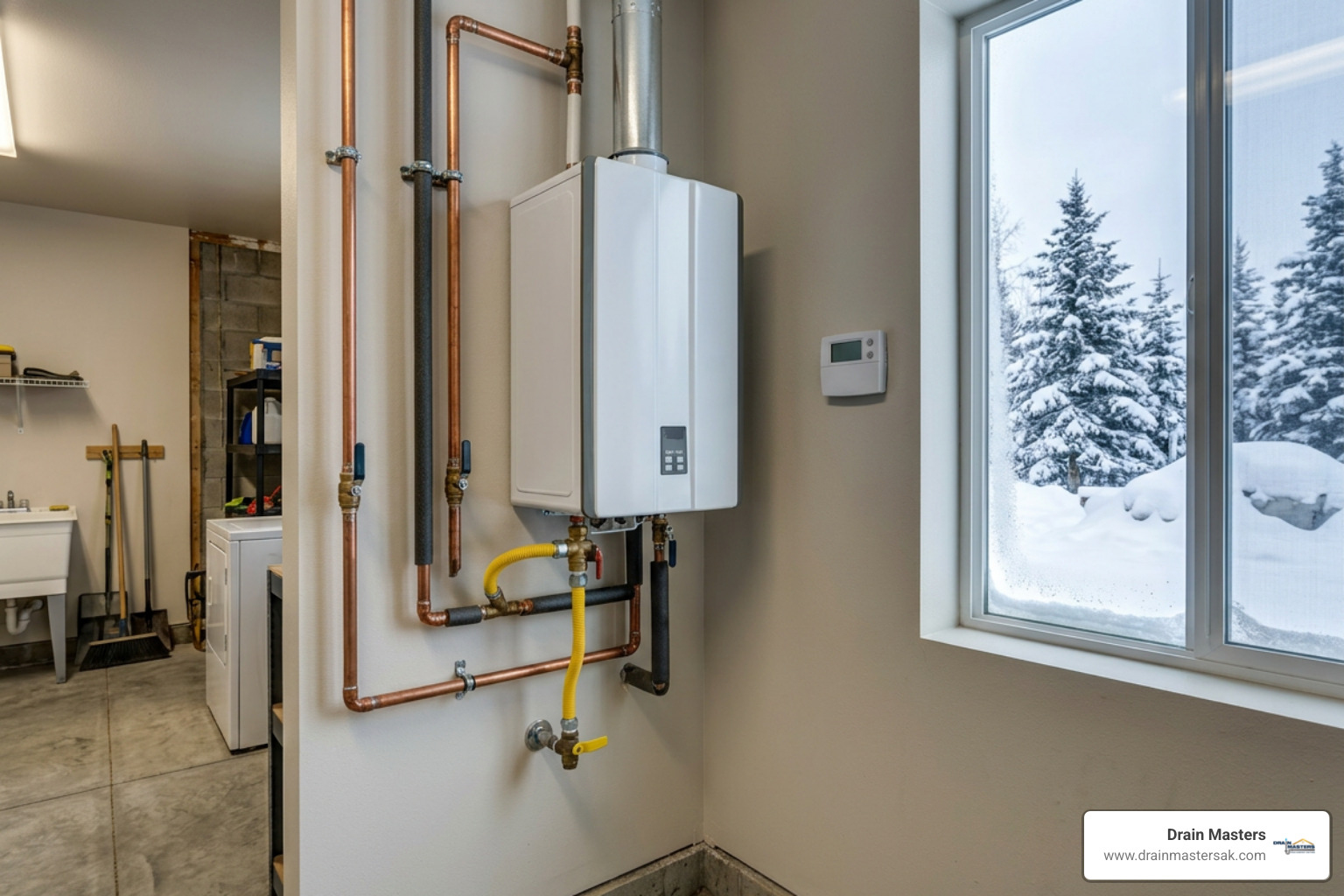
Is a Tankless Water Heater Worth It in Anchorage, AK?
Yes, a properly sized tankless water heater can be worth it in Anchorage, AK. It provides continuous hot water, uses no energy to keep a large tank warm, and can free up utility room space. The key is sizing it for the very cold winter water in Southcentral Alaska, which frequently enters the home near 36°F. An undersized unit will deliver less hot water or lower water pressure whenever more than one fixture is in use.
Tankless systems operate on an on-demand principle, firing up only when you turn on a hot water faucet or start an appliance. This eliminates standby heat loss completely, which is a major factor in subarctic climates where basement and mechanical room temperatures often drop during winter months. However, heating near-freezing water requires a significantly larger thermal capacity than standard residential systems installed in temperate parts of the country. For whole-home installations, selecting a high-output natural gas unit, upsizing gas supply piping, routing direct-vent combustion lines safely above the snowdrift line, and maintaining an annual descaling routine are all vital steps.
While on-demand water heating delivers major benefits, it is not an identical plug-and-play solution for every household. Rural cabins, smaller secondary homes, residences with 100-amp electrical panels, off-grid propane systems, and properties with private wells carrying high mineral concentrations require customized engineering. Taking the time to evaluate total household demand during sub-zero cold snaps ensures you get reliable performance without unexpected drops in water pressure or temperature.
At Drain Masters, our local Anchorage, AK plumbing team brings more than two decades of hands-on experience supporting plumbing operations, technical training, and service quality. In this comprehensive guide, we will walk you through the practical engineering, sizing formulas, venting realities, and financial considerations behind choosing a tankless water heater Anchorage homeowners can rely on through the coldest sub-zero winter weather.
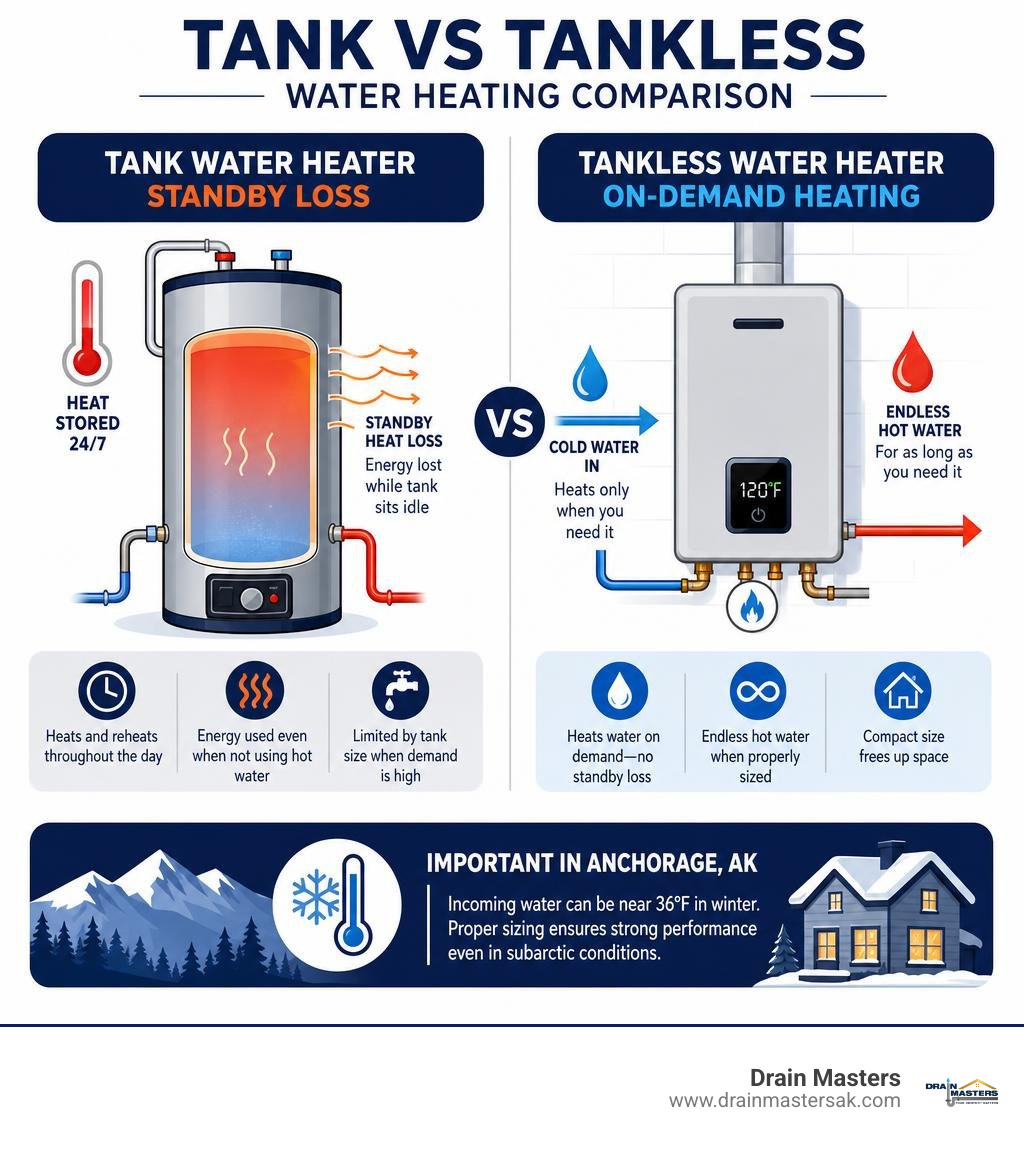
How Freezing Subarctic Groundwater Affects On-Demand Performance
Living in Southcentral Alaska requires homeowners to adapt every household mechanical system, including heating, ventilation, and plumbing, to withstand extended deep freezes. Traditional storage water heaters constantly burn fuel or consume electricity to keep 40 to 80 gallons of water hot 24 hours a day, 7 days a week. While a full tank provides a predictable volume of hot water for a single shower, it leads to continuous standby heat loss as heat escapes into cool utility spaces. In standard households across the region, domestic water heating accounts for roughly 25% to 30% of total residential energy consumption.
When evaluating professional water heater services for an efficiency upgrade, understanding the mechanics of on-demand heating during January and February is essential. A tankless unit does not hold standing water. Instead, cold municipal water from Eklutna or private well water enters the unit, travels through a heavy-duty heat exchanger, absorbs intense thermal energy instantaneously, and flows straight to your open fixtures at the exact temperature selected on your digital controller.
Why Groundwater Temperatures Impact Tankless Water Heater Anchorage Sizing
In warmer regions of the country, incoming groundwater enters plumbing lines at a mild 55°F to 70°F. In Anchorage, AK, municipal water mains and private well aquifers drop significantly, often reaching as low as 36°F from November through April. This low starting point fundamentally changes the physical workload placed on the heating chamber.
To produce a comfortable shower at a standard delivery temperature of 116°F to 120°F, your heating equipment cannot rely on a modest bump in heat. It must deliver a steep 80°F temperature rise, commonly referred to in the plumbing industry as the temperature rise or delta-T. When a burner encounters water hovering just a few degrees above freezing, it must fire at maximum output. If a unit lacks the thermal capacity to achieve this 80°F jump at full flow, its built-in flow control valve automatically slows down the water flow to protect the target temperature, resulting in reduced water pressure at your showerheads and sink faucets.
Flow Rate Realities and Temperature Delta-T Calculations
Plumbing flow rates are measured in gallons per minute (GPM). A standard modern shower fixture uses approximately 2.0 to 2.5 GPM, while a kitchen faucet, bathroom vanity, or dishwasher requires between 1.0 and 1.8 GPM. In mild climates with 60°F groundwater, a premium on-demand unit easily produces 8.5 to 9.5 GPM because it only needs to lift the temperature by 50°F to 55°F.
For homeowners comparing installation options, the Drain Masters did you know resource library is a helpful place to learn how local water conditions, maintenance habits, and fixture demand affect long-term plumbing performance in Anchorage, AK homes.
In subarctic environments, that exact same heating unit must divide its burner power across an 80°F climb. When incoming water drops to 36°F, a high-output gas unit delivering an 80°F rise will produce a continuous capacity between 4.0 and 4.7 GPM. That output is more than enough to supply two simultaneous hot showers without running cold, provided the unit was engineered with a high-efficiency copper or dual stainless steel heat exchanger capable of rapid thermal conduction.
| Performance Metric | Traditional Storage Tank | Subarctic-Sized Tankless Unit |
|---|---|---|
| Hot Water Supply | Limited to stored volume (40 to 80 gal) | Continuous and endless |
| Winter Baseline (36°F water) | Recovers slowly once depleted | Maintains set output continuously |
| Standby Heat Loss | Continuous round-the-clock loss | Zero (heats strictly on demand) |
| Typical Equipment Lifespan | 10 to 15 Years | 20+ Years |
| Physical Space Requirement | Large floor footprint in utility space | Compact wall-mounted chassis |
| Energy Reduction Potential | Standard baseline efficiency | Reduces water heating costs up to 35% |

Sizing and Selecting a Tankless Water Heater Anchorage Demands for Sub-Zero Winters
Accurate sizing is the foundation of a successful installation for modern tankless water heaters across Southcentral Alaska. In our northern climate, relying on national generic sizing charts found on retail packaging will result in insufficient hot water during the coldest winter weeks. Sizing must calculate total peak fixture usage alongside maximum winter delta-T to determine exact burner capacity.
Gas vs. Electric Units for Cold Climates
Homeowners frequently ask whether electric or natural gas models perform better in cold climates. While electric tankless systems do not require exterior venting pipes or gas connections, they present serious electrical challenges in northern regions:
- Whole-Home Electric Units: Heating 36°F groundwater to 116°F at a whole-house flow rate of 4.0 to 4.5 GPM requires massive electrical power, typically between 27 kW and 36 kW. This translates to drawing 120 to 150 amps of continuous power, requiring three or four dedicated 40-amp or 50-amp 240V breakers. Most older homes in Anchorage, AK, have 100-amp or 150-amp main electrical services, making an expensive 200-amp or 300-amp electrical panel replacement mandatory before an electric unit can even be connected.
- Natural Gas Units: Natural gas is the most dependable, powerful, and cost-effective energy source for whole-house tankless systems in Anchorage, AK. Natural gas units modulate their burner output instantly, delivering consistent flow rates through extended deep freezes without overloading your electrical system.
- Liquid Propane (LP) Units: For rural properties, outbuildings, or cabins operating on liquid propane, fuel supply sizing is critical. Propane requires ambient temperature to vaporize from a liquid into a gas. During prolonged sub-zero snaps, small exterior propane cylinders lose pressure, starving high-BTU burners of the fuel required to heat freezing water. Installing properly sized high-capacity propane tanks or vaporizing equipment resolves this issue.
BTU Requirements and Whole-Home vs. Point-of-Use Solutions
For a standard whole-home installation in Anchorage, AK, units rated between 180,000 BTU and 199,000 BTU are recommended. A 199,000 BTU burner provides the necessary thermal horsepower to overcome extreme incoming water temperatures, ensuring comfortable delivery across multiple fixtures at the same time.
For smaller properties such as detached shops, mother-in-law suites, or remote cabins, a dedicated point-of-use unit may be considered. However, because incoming winter water is exceptionally cold, even a single-fixture system in Alaska requires robust heating output. In high-demand residential layouts, installing an on-demand unit equipped with an internal recirculation pump or small buffer tank eliminates the brief delay of unheated water, preventing the cold-water sandwich effect and delivering immediate hot water to distant bathroom and kitchen taps.
Essential Installation, Space, and Venting Requirements in Anchorage, AK
Upgrading to an on-demand water heating system involves more than removing an old tank and hanging a new cabinet. It requires mechanical modifications to comply with regional safety standards and local building codes. Coordinating with a licensed plumbing team ensures your setup meets local municipal requirements and performs reliably during winter weather.
Replacing Old Storage Tanks and Retrofitting Utilities
Conventional water heaters occupy considerable floor space in basements, mechanical rooms, or utility closets. Modern on-demand units mount directly onto wall framing, freeing up clean floor space for storage or other equipment. However, replacing an old storage unit requires several mechanical upgrades:
- Gas Supply Line Sizing: Standard storage water heaters operate with 35,000 to 40,000 BTU burners fed by standard 1/2-inch gas piping. Whole-house on-demand units draw up to 199,000 BTU at peak operation. To prevent burner starvation and maintain safe gas pressure for other appliances like your furnace, the gas line often needs to be upsized to a dedicated 3/4-inch or 1-inch pipe running from the gas meter or manifold.
- Combustion Air and Dedicated Venting: Atmospheric storage tanks vent passively up a central chimney flue. High-efficiency tankless units use sealed, motorized direct-vent combustion systems that draw fresh outdoor combustion air through an intake pipe and exhaust flue gases horizontally through an exterior wall or vertically through the roof.
- Dedicated Electrical Circuits: Although gas-powered tankless units burn natural gas or propane for heat, they need a dedicated 120V electrical outlet to power internal computer boards, electronic ignition igniters, motorized exhaust fans, and built-in freeze-protection heaters.
- Condensate Management: High-efficiency condensing units extract additional thermal energy from exhaust gases, creating a mildly acidic condensate byproduct. Proper installation requires running a dedicated acid-resistant drain line with a neutralizer kit to protect your home’s drainage piping.
If a retrofit reveals corroded shutoff valves, aging supply lines, or leaks around the old tank location, pairing the water heater upgrade with targeted professional plumbing repairs can prevent callbacks and protect the new equipment from avoidable pressure or drainage problems.
Winter Freeze Protection and Intake Venting Safeguards
Sub-zero air drafting into exterior exhaust or intake flues can freeze and crack a water-filled heat exchanger if proper precautions are not taken. Quality cold-climate systems utilize sealed direct-vent configurations, such as concentric venting, polypropylene (PP) pipe, or specialized Category III stainless steel exhaust piping to maintain an airtight seal.
Modern tankless systems feature built-in electric freeze-protection heating elements attached to internal water passages, preventing freezing when outdoor temperatures plunge well below zero. Exterior intake and exhaust terminations must be installed at a code-compliant clearance height well above historic snowdrift levels. In addition, all exposed domestic water piping inside unconditioned or semi-conditioned utility spaces should be protected with high-density foam insulation and thermostatically controlled heat trace cables.
Maintenance, Mineral Management, and Financial Incentives
A properly installed and maintained tankless system offers outstanding operational durability, delivering an expected service life of more than 20 years, which is significantly longer than the 10-to-15-year life expectancy of a traditional storage tank. Maximizing equipment lifespan requires routine care and proactive mineral control.
Upfront Costs and Long-Term Savings of a Tankless Water Heater Anchorage Installation
Because tankless water heaters only burn fuel when hot water is flowing, they eliminate standby fuel consumption and can reduce domestic water heating costs by up to 35%. For Anchorage, AK homeowners with typical daily hot water use, a properly sized on-demand system can offer strong long-term efficiency compared to a standard storage tank while still delivering reliable hot water through cold winter conditions.
Local gas and electric utilities across Southcentral Alaska periodically offer rebate programs for homeowners upgrading to high-efficiency qualifying equipment. In addition, federal tax incentives under current energy policies reward homeowners who choose appliances with qualifying Uniform Energy Factor (UEF) ratings. To make equipment upgrades manageable for any household budget, you can take advantage of budget-friendly financing options that fit your project goals.
The Drain Masters pipes blog archive also covers seasonal plumbing concerns that matter in Anchorage, AK, including preventive maintenance, freeze protection, and practical ways to reduce avoidable wear on water heating equipment.
Annual Descaling and Combating Hard Water Mineral Scale
Although the high-velocity flow inside compact heat exchangers helps minimize loose sediment buildup, rapid temperature changes cause dissolved calcium and magnesium minerals in hard water to precipitate out. Over time, these minerals form a hard scale layer on internal heat exchanger tubes. This scale acts as a thermal insulator, forcing the burner to work harder, lowering energy efficiency, and eventually causing the system to display error codes.
To preserve efficiency and protect internal parts, schedule preventative plumbing maintenance once every twelve months. During this service, a certified technician connects circulation hoses to the unit’s dedicated isolation service valves and flushes an environmentally safe descaling solution through the heat exchanger for 45 to 60 minutes. This process dissolves mineral scale, clears the cold-water inlet debris filter, and allows the technician to verify combustion performance and check safety sensors.
Because working on gas lines, high-voltage circuits, and specialized venting involves serious safety considerations, DIY modifications are not recommended. Always trust certified plumbing professionals for safe, code-compliant maintenance and repair work.
Frequently Asked Questions About Tankless Water Heaters in Anchorage, AK
What is the typical cost range for installing or servicing a tankless water heater in Anchorage, AK?
The total cost to maintain or install a tankless water heater in Anchorage, AK, depends on existing utility layouts, gas line diameter, electrical supply availability, direct-vent exhaust routing, and the BTU capacity of the selected unit. Scheduling an in-home evaluation provides an accurate, transparent quote based on your specific floor plan.
How do tankless water heaters perform when winter groundwater drops to 36°F?
When properly sized for subarctic conditions by an experienced technician, high-output units perform reliably with 36°F groundwater. The burner modulates to supply water at your selected temperature, though maximum simultaneous flow capacity adjusts to accommodate the steep 80°F temperature rise.
What size or BTU rating is recommended for an Anchorage home or cabin?
For a standard whole-home installation in Anchorage, AK, a unit rated between 180,000 BTU and 199,000 BTU is recommended. This capacity delivers continuous hot water across multiple fixtures simultaneously, even during peak winter conditions.
Should I choose a natural gas, propane, or electric tankless water heater in Alaska?
Natural gas is the most dependable and economical choice for whole-home systems in Anchorage, AK. Propane is an excellent option for rural or off-grid properties when paired with an adequate fuel tank. Electric whole-home tankless units are generally impractical in Alaska because freezing groundwater requires excessive electrical amperage that often necessitates costly main electrical service upgrades.
What routine maintenance is required for a tankless system in Anchorage, AK?
Annual descaling and flushing through dedicated isolation valves is essential to clear hard water mineral scale from the heat exchanger. Routine maintenance also includes cleaning the cold-water inlet filter screen, inspecting intake and exhaust flues for ice or snow obstructions, and verifying electrical freeze-protection circuits.
Can a tankless unit be installed in the exact same spot as an old tank water heater?
Yes, a tankless unit can be installed in the space previously occupied by a storage tank. Because on-demand units mount to wall framing, you will gain open floor space, though the project requires installing dedicated direct-vent piping and often upsizing the gas supply line.
What tankless water heater features perform best in subarctic conditions?
The most dependable units for subarctic climates include high-output modulating gas burners up to 199,000 BTU, heavy-duty commercial copper or dual stainless steel heat exchangers, built-in electric freeze-protection heating blocks, and direct-vent sealed combustion.
What energy efficiency rebates or tax credits are available in Alaska?
Homeowners in Alaska who install qualifying high-efficiency tankless water heaters can access federal energy efficiency tax credits as well as periodic rebate incentives from local gas and electric utilities, reducing overall project costs.
How long does a tankless water heater last compared to a conventional storage tank?
A properly maintained tankless water heater typically lasts 20 years or longer. In comparison, traditional storage water heaters have an average operational lifespan of 10 to 15 years due to internal tank corrosion and sediment accumulation.
Is a point-of-use tankless unit practical for a cabin or single bathroom in Alaska?
Point-of-use units work well for single low-demand fixtures like an isolated half-bath sink or workshop tap. However, because incoming winter water is near freezing, running a shower still demands high heating power, making a high-capacity gas unit or small buffer setup the more practical solution.
Conclusion
Upgrading to an on-demand hot water system is an effective way to modernize your plumbing, eliminate standby energy waste, and secure endless hot water through our coldest sub-zero winter spells. While subarctic groundwater demands precise equipment sizing, dedicated gas lines, and specialized venting configurations, a professionally engineered system delivers dependable performance, lower utility bills, and decades of reliable home comfort.
When you are ready to explore your hot water options, trust the local team at Drain Masters. We have proudly served our community for more than two decades, providing upfront pricing, advanced diagnostic tools, and master-level plumbing expertise. You can contact our professional water heater technicians with questions about your home, cabin, or small business system today.