
What Is Drain Patch Repair and How Does It Work?
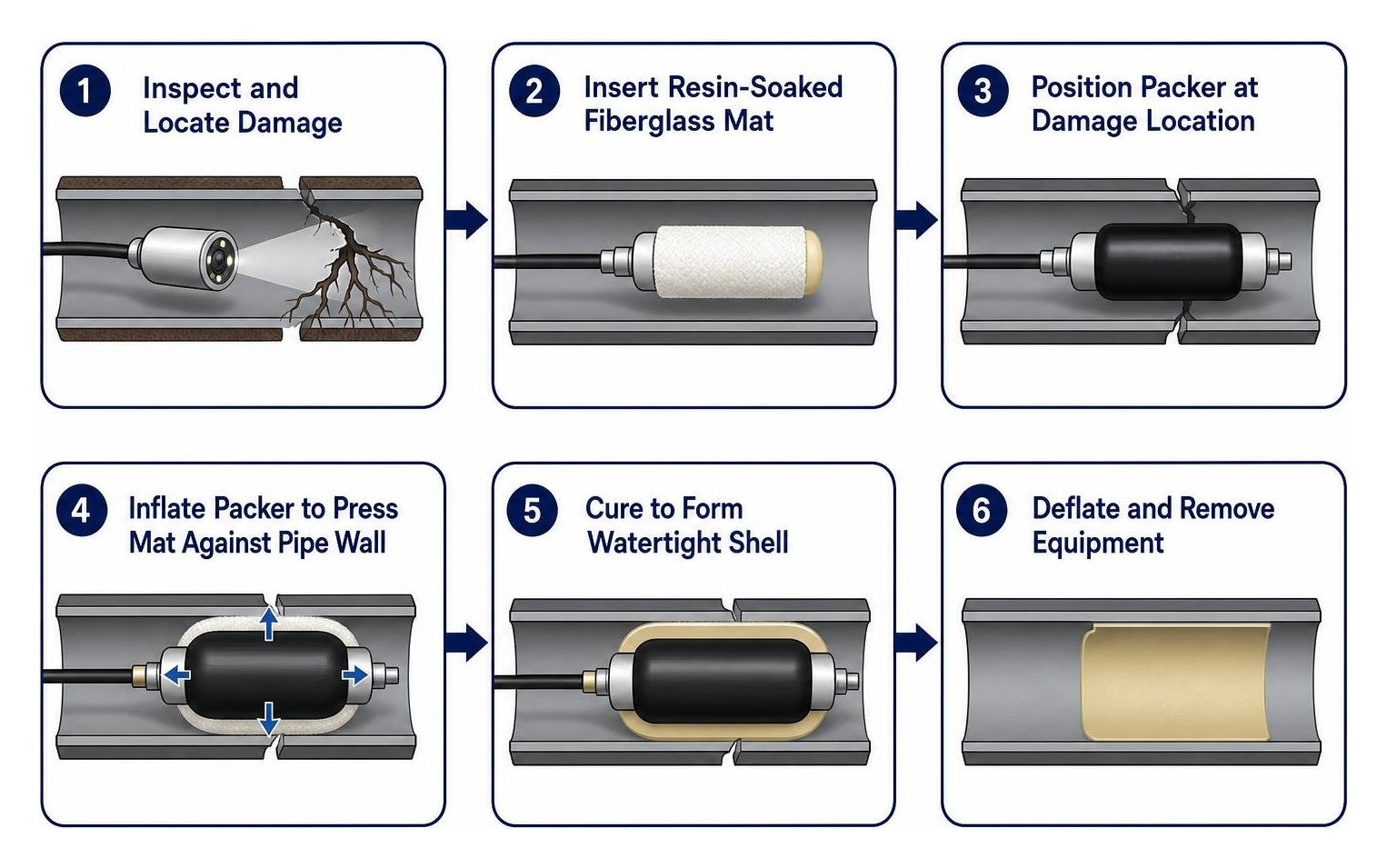
Trenchless drain patch repair, commonly referred to in the plumbing industry as sectional point repair, is an advanced non-invasive rehabilitation method designed to restore structurally compromised underground piping from the inside out. Rather than unearthing buried sewer or storm infrastructure with heavy excavation machinery, trenchless technicians insert a resin-saturated fiberglass mat directly into the host line through standard plumbing cleanouts.
This precision process utilizes a specialized cylindrical inflatable tool known as a packer. The technician navigates the packer through the pipeline to the exact physical coordinates of the pipe defect using continuous optic guidance. Once positioned directly over the breach, the packer expands using regulated pneumatic air pressure. As the inflatable bladder pushes outward, it presses the resin-drenched fiberglass sleeve tightly against the interior host pipe wall. The repair material molds seamlessly to the internal circumference, bridging structural voids, sealing open joint seams, and curing into a smooth, watertight, and load-bearing structural sleeve within the existing line.
By targeting specific structural vulnerabilities without excavating large sections of earth, point patching provides a durable, cost-effective alternative to trenchless sewer repair when the broader pipeline remains fundamentally sound.
Common Causes and Warning Signs of Underground Pipe Failure
Subterranean sewer and drainage lines face constant environmental stress, dynamic ground movement, and chemical exposure. Recognizing early symptoms of deterioration allows residential and commercial property owners to intervene before a minor fissure deteriorates into a catastrophic pipe collapse.
- Soil Movement and Frost Heave: Natural ground settling, dynamic seismic activity, and severe seasonal freeze-thaw cycles exert immense shear pressure on buried rigid pipelines, resulting in offset joints and shear cracking.
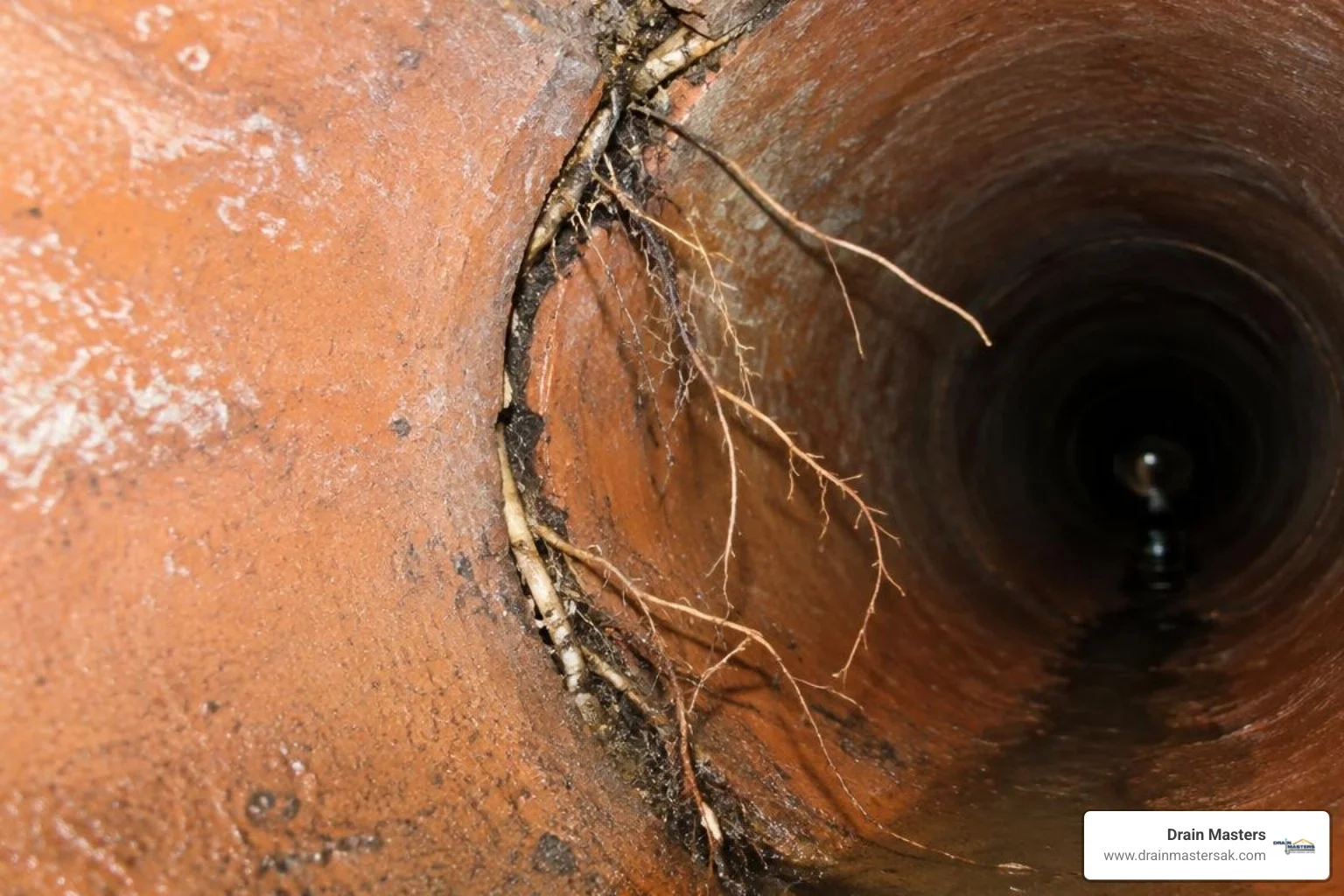
- Aggressive Root Intrusion: Tree and shrub roots naturally seek subterranean moisture and nutrient sources, exploiting micro-fissures or unsealed joint caulking. As root systems expand inside the pipe, they break apart pipe walls and create persistent structural clogs.
- Internal Corrosion and Age: Older cast iron and ductile iron lines suffer from oxidation, acidic buildup, interior rust scale accumulation, and severe bottom-channeling over decades of continuous usage.
- Persistent or Recurring Blockages: Drains that clear temporarily after cable snaking but clog again shortly after typically indicate a jagged structural fracture or separated joint catching solid waste.
- Escaping Sewer Gas Odors: Unpleasant hydrogen sulfide odors permeating yards, crawlspaces, or basements indicate an unsealed fracture in the main sewer lateral where noxious gases escape.
- Lawn Depressions and Wet Spots: Unexpected soggy patches, lush patches of grass, or ground sinkholes suggest that wastewater is saturating the bedding soil, which the Environmental Protection Agency (EPA) identifies as a serious threat to local ground ecosystems and public sanitation.
Types of Pipe Defects Fixed by Sectional Drain Patching
Sectional point repairs are engineered specifically to correct localized physical damage within isolated sections of pipe. This targeted approach is ideal for:
- Circumferential and Longitudinal Fractures: Structural cracks spanning along the pipe length or wrapping around the pipe body.
- Offset and Misaligned Joints: Separations between connected pipe sections caused by soil shifts that allow raw sewage to leak into the ground.
- Root Infiltration Entry Points: Punctures, cracked hubs, and compromised gaskets where tree root clusters enter the sewer channel.
- Pinhole Leaks and Localized Wall Loss: Isolated areas of severe internal oxidation, chemical etching, or wall thinning in an otherwise stable line.
The Step-by-Step Sectional Point Repair Process
Executing an internal sectional point repair requires specialized equipment, strict procedural discipline, and precise timing. Professional technicians follow established industry standards to ensure a permanent, high-strength structural bond, reflecting the foundational principles of how no-dig pipe repairs work.
Camera Inspection and Pipe Preparation
Every point repair begins with a comprehensive optical survey. Technicians guide a high-resolution, self-leveling diagnostic camera through an accessible cleanout to perform a detailed sewer camera inspection. This step identifies the exact linear footage, orientation, and severity of the pipe defect. Technicians carefully mark the distance from the access point directly on the push rod system to ensure pinpoint accuracy during bladder insertion.
Before installing any repair sleeve, the host pipe must undergo mechanical line preparation through professional drain cleaning. High-pressure hydro-jetting equipment and specialized mechanical descaling chains strip away grease deposits, heavy mineral scale, rust nodules, and invasive root masses. This intensive cleaning process profiles the host pipe interior, creating an optimal bonding surface for the curing resin. A follow-up camera inspection confirms that the pipe interior is clean and ready for patching.
Impregnation, Packer Inflation, and Ambient Curing
Once surface preparation is complete, technicians mix a two-part ambient-cure silicate or epoxy resin system to a uniform consistency. The liquid resin mixture is poured onto a precision-cut fiberglass and felt mat, then thoroughly compressed using mechanical rollers to achieve complete, void-free saturation.
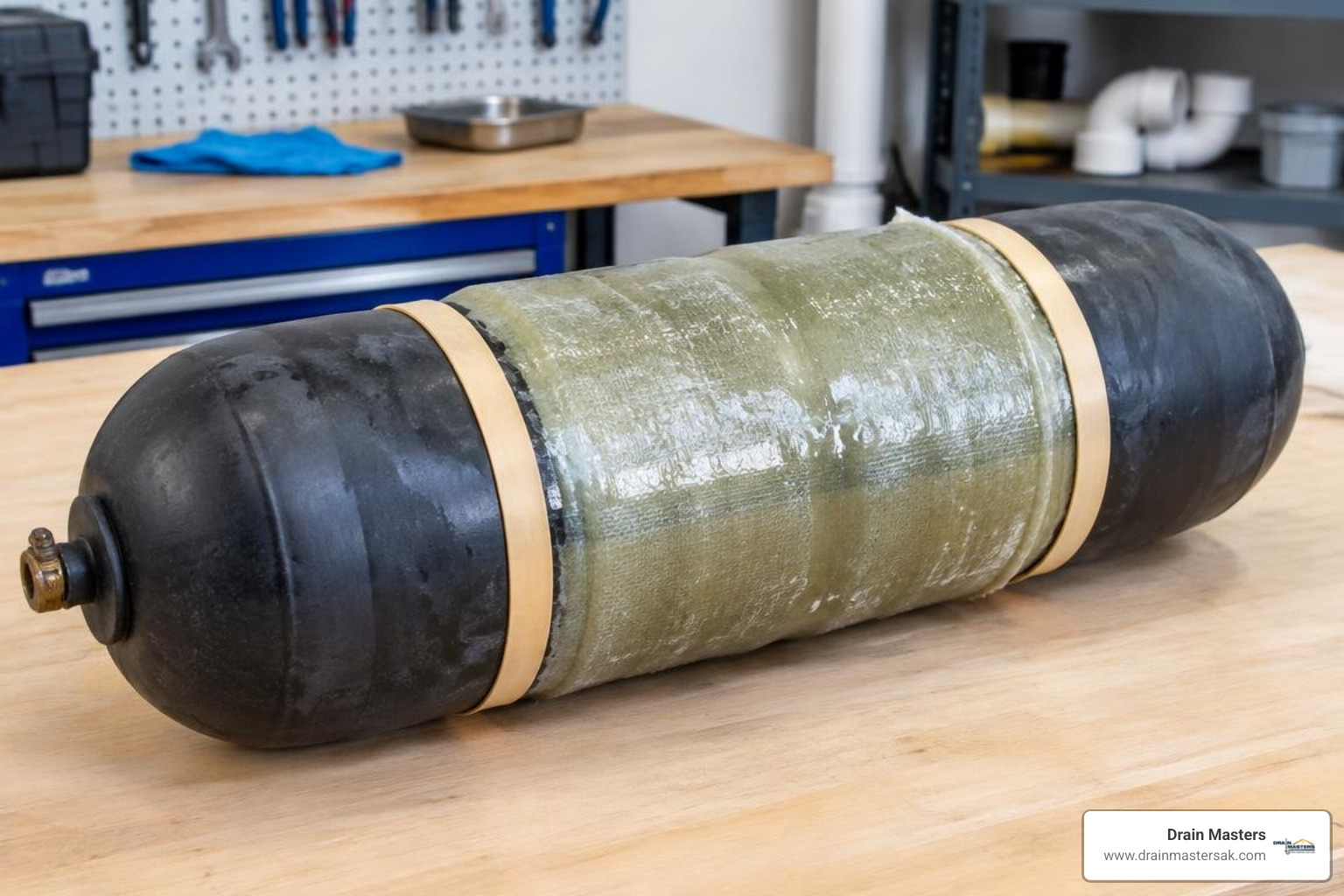
Technicians securely wrap the saturated patch around a flexible rubber packer, holding it in place with calibrated elastic bands. The assembly is guided down the pipeline to the exact target footage. Once confirmed on the diagnostic camera monitor, the technician inflates the packer with regulated air pressure, breaking the retaining bands and forcing the resin-soaked patch firmly against the host pipe interior.
The bladder remains fully inflated under constant pressure throughout the curing phase. Curing times vary based on ambient soil temperatures:
- Warm ground conditions (approximately 73°F): Working time of 15 to 17 minutes with a full cure achieved within 60 to 70 minutes.
- Moderate ground conditions (approximately 55°F): Working time of 18 to 20 minutes with a full cure achieved within 90 to 110 minutes.
- Cold ground conditions (approximately 33°F): Working time of 20 to 22 minutes with a full cure achieved within 100 to 120 minutes.
After the structural sleeve hardens into a rigid composite, the packer is vacuum-deflated and retrieved. Technicians then conduct a final diagnostic camera pass to verify structural bonding, smooth transition edges, and unhindered hydraulic flow.
Comparing Sectional Patch Repair with Other Restoration Methods
Selecting the best sewer rehabilitation strategy requires evaluating the overall structural condition of the pipeline, budget constraints, and site logistics. Comparing point repairs against full-length pipe lining and open-cut excavation clarifies the advantages of targeted trenchless technology.
Point Repair vs. Broader Pipe Rehabilitation
Sectional patch repair is the most practical choice when structural defects are isolated to a specific section of an otherwise stable line. In contrast, full-length cured-in-place pipe (CIPP) lining or traditional open-trench replacement is necessary when the pipeline suffers from widespread structural failure, continuous joint decay, or severe systemic degradation along its entire run.
| Feature | Trenchless Patch Repair | Full Cured-in-Place Pipe (CIPP) Lining | Traditional Open-Cut Replacement |
|---|---|---|---|
| Scope of Fix | Targeted spot repair (typically 2 to 6 feet) | Entire pipe run from cleanout to main | Complete removal and replacement of pipe |
| Landscape Disruption | Zero excavation; cleanout access | Zero to minimal excavation | Extensive trenching through yards/driveways |
| Installation Time | 1 to 3 hours | 4 to 8 hours | Multiple days to over a week |
| Structural Lifespan | Up to 50 years | Up to 50 years | 50 to 100 years (depending on pipe material) |
| Pipe Diameter Impact | Negligible reduction (~3-4mm wall) | Minimal continuous reduction | Restores full original interior diameter |
Structural Limitations and When Patching Is Not Viable
While point repair is an exceptionally versatile rehabilitation method, it relies on the host pipe to maintain circular geometry during the curing process. In certain severe situations, sectional patching is not recommended:
- Total Pipe Collapse or Missing Inverts: Crushed sections where the packer cannot safely navigate or where large portions of the pipe bottom are entirely missing.
- Severe Backfall and Slope Failure: Significant grade sags or bellies where standing wastewater continuously gathers, requiring structural re-leveling.
- Excessive Ovality and Deformation: Pipelines that have experienced severe radial deflection exceeding 20 to 30 percent of their original diameter.
- Continuous Multi-Joint Failure: Runs suffering from continuous cracking and root intrusion across the entire length, where full lining or traditional sewer line repair is required.
Longevity, Pipe Compatibility, and Repair Durability
Evaluating trenchless point repair involves assessing the mechanical bond strength, chemical resistance, and long-term durability across different pipe materials. Modern silicate and epoxy resins deliver long-lasting structural performance without requiring destructive surface excavation.
Durability Across Cast Iron, Clay, and Plastic Pipes
Modern trenchless silicate and epoxy resin formulations exhibit outstanding adhesion and mechanical locking across various pipe materials:
- Vitrified Clay Pipe: Common in older residential neighborhoods, vitrified clay is brittle and susceptible to fracture at joints. Point patches bond tightly to clay, bridging joint gaps and creating a root-proof barrier.
- Cast Iron and Ductile Iron: Cast iron lines suffer from internal oxidation and rough scaling. Once mechanically descaled, structural point patching provides a proven solution for restoring aging sewer lines in older homes, smoothing out rough interior walls and bridging longitudinal fractures.
- PVC and ABS Plastics: Thermoplastic pipes can crack due to sharp rocks, uneven bedding, or sudden ground shifting. Flexible fiberglass patch sleeves bridge cracked plastic walls while accommodating normal thermal expansion.
Cured sectional patches provide impressive pressure ratings between 200 and 500 PSI. They remain impervious to household chemical cleaners, sewer gases, and groundwater intrusion, delivering an engineered service lifespan of up to 50 years. For homeowners weighing repair options for older pipes, our guide to sewer line repairs in older homes explains when broader rehabilitation may be appropriate.
Temporary Emergency Fixes vs Professional Drain Patch Repair
When a sewer line begins leaking in an exposed basement, crawlspace, or utility room, property owners frequently implement temporary emergency measures to contain leaks before permanent repairs occur.
Common temporary measures include:
- Rubber Pipe Sleeves with Band Clamps: Fastening a heavy-duty elastomeric sleeve over an exposed crack using stainless steel screw clamps.
- Two-Part Epoxy Putties: Manually pressing moisture-resistant epoxy putty directly into a small crack on an accessible, dry pipe surface.
- Silicone Repair Wraps: Wrapping self-fusing silicone or resin tape tightly around a visible pinhole leak.
While these DIY emergency measures temporarily contain wastewater leaks on accessible pipes, they do not provide structural load-bearing capacity for buried pipes. Underground pipelines require the compressive strength and seamless sealing of professional trenchless repair to withstand heavy soil loads, vehicular traffic, and groundwater pressure.
Frequently Asked Questions
How long does a cured trenchless patch repair last?
A professionally installed sectional patch repair provides an engineered service life of up to 50 years under normal operating conditions. The composite fiberglass and silicate resin create a durable, corrosion-proof structural shell that withstands internal waste flow, sewer gases, and external soil pressure.
What types of pipe materials can be patched with sectional repair?
Point repairs bond reliably to vitrified clay, cast iron, ductile iron, PVC, ABS, and concrete sewer piping, provided the host line is thoroughly cleaned and descaled before installation.
How does cold ground temperature affect resin curing times?
Cold ground temperatures slow down the exothermic chemical reaction of the resin. Curing at temperatures around 33°F requires 100 to 120 minutes, compared to 60 to 70 minutes at 73°F. Professional technicians adjust chemical formulations and monitor pressure gauges closely during cold installations.
Can a sectional point repair permanently stop root intrusion?
Yes. Once existing roots are cut and hydro-jetted away, the resin-saturated patch cures directly over the joint or fracture, sealing the entry point with an airtight and watertight structural barrier that roots cannot penetrate.
Is trenchless point repair more cost-effective than pipe replacement?
Yes. Because sectional point patching utilizes existing cleanouts and requires no excavation, it eliminates the substantial costs associated with heavy machinery, trenching, and rebuilding driveways, patios, or landscaping.
Can a patch repair fix a fully crushed or collapsed sewer line?
No. Sectional point repair requires an intact host pipe to support and shape the inflatable packer during curing. If a pipe has suffered complete collapse or severe deformation, excavation or pipe bursting is necessary.
How long does a point repair installation take from start to finish?
Most sectional repairs are completed within 1 to 3 hours. This timeframe includes the diagnostic camera survey, high-pressure hydro-jetting, packer placement, curing, and final optical inspection.
Does installing an internal patch liner reduce pipe flow capacity?
The wall thickness of a cured patch is only 3 to 4 millimeters, resulting in a negligible reduction in pipe diameter. The ultra-smooth interior surface often improves overall flow velocity by reducing friction and eliminating snag points.
Can a trenchless point repair navigate pipe bends and offsets?
Yes. Technicians use highly flexible, specialized bladders designed to navigate sweeping turns, 45-degree bends, and slight joint offsets without wrinkling or bunching.
Can I install an internal structural sewer patch as a DIY project?
No. Trenchless point repair requires pneumatic bladders, calibrated pressure regulators, high-pressure cleaning jetters, and diagnostic inspection optics. An incorrectly positioned patch can cause a permanent pipe obstruction, making professional installation essential.
Conclusion: Long-Lasting Structural Restoration
Trenchless sectional point repair provides property owners with a reliable, minimally invasive solution for repairing damaged underground sewer lines. By targeting cracked walls, offset joints, and root intrusion points from within the pipeline, this advanced method restores structural strength without the high expense and destruction of excavating lawns, driveways, or landscapes.
When your property requires dependable, long-lasting drainage solutions, trust the skilled team at Drain Masters. We bring extensive local experience, advanced diagnostic tools, and proven workmanship to every project. To schedule a comprehensive video inspection and discuss the safest next step for your sewer line, contact our professional drain patch repair technicians.